




Revolut Reaches $75B Valuation, Anthropic Climbs to $350B on Microsoft–Nvidia Backing, xAI Eyes $230B Valuation
By Stableton on November 26th, 2025
Here’s what stood out this week across our portfolio holdings: a major fintech player reaches a landmark secondary valuation that reinforces renewed strength in late-stage pricing, an AI leader secures multi-billion-dollar commitments from Microsoft and Nvidia that reshape the competitive landscape, and a fast-scaling frontier model company accelerates toward a $230B valuation as infrastructure demand surges. Let’s dive in…
THIS WEEK’S BREAKING NEWS
Revolut surges to $75B after major secondary sale
Revolut has reached a $75B valuation after finalizing a major secondary share sale, marking one of the largest private-market pricing events in global fintech. The round attracted Coatue, Greenoaks, Andreessen Horowitz, and Nvidia’s venture arm, signalling strong institutional appetite for scale-stage fintech and reinforcing Revolut’s status as one of the sector’s most valuable private companies ahead of any liquidity event. (1)
MARKET UPDATE
Rebounding U.S. IPO volumes signal healthier issuance pipeline
US IPO activity strengthened meaningfully in 2H25, raising about $22B and reaching the highest post-Covid levels. The SEC shutdown created a review backlog, yet companies already advanced in the process still have a viable December window. Roughly 60 additional filers, including Medline with an expected $5B listing, now form a sizeable pipeline that supports a more active start to 2026 rather than a missed cycle. (2)
Europe’s IPO pipeline revitalizes with strong post-summer cohort
Europe’s IPO market is showing clear signs of revival. A strong set of listings since September, led by Verisure’s $4.3B deal and supported by issuers like Noba Bank Group and Ottobock, has traded mostly higher and lifted confidence across ECM desks. EMEA has raised more than $21B this year, and bankers see visibility on a multibillion-dollar pipeline for 2025 and 2026 as market conditions improve. (3)
STABLETON MORNINGSTAR PITCHBOOK UNICORN 20 STRATEGY

The Stableton Morningstar PitchBook Unicorn 20 strategy is the world’s first passive, systematic, and semi-liquid approach to investing in the Top 20 privately held tech companies before they go public.
This strategy offers a straightforward and cost-effective way to gain exposure to leading private technology companies within a single portfolio. With no performance fees and enhanced liquidity, it offers a unique alternative to traditional private market investments.
STABLETON NEWS
Join us for a live webinar on the future of private markets

Next Wednesday, on December 3, 2025 at 15:00 CET, Stableton is joining Morningstar Indexes and PitchBook to address one of the biggest challenges in private blue-chip tech investing: How do you benchmark and scale something that's historically been opaque and illiquid?
The conversation will reveal just how fast private markets are evolving:
Robert Edwards, Managing Director of Indexes at Morningstar, will share how Morningstar is approaching to private market indexing, including the launch of its Modern Market 100 Index: the first benchmark designed to track both public leaders and late-stage giants like SpaceX and OpenAI side-by-side.
Emily Zheng, Senior VC Researcher at PitchBook, will present new research on the venture secondaries market, showing how it’s moving from subjective pricing models toward mark-to-market transparency, enabling more robust and scalable portfolio allocation at an institutional level.
Andreas Bezner, CEO and Co-Founder of Stableton, will outline our systematic approach to private blue-chip tech investing and explain why index-oriented growth equity is transitioning from a niche strategy into a core portfolio allocation.
Register below to secure your spot for this 45-minute deep dive into the future of private blue-chip tech investing.
PORTFOLIO NEWS
Anduril integrates Allied sensor network for NATO defense
Anduril supported NATO’s Eastern Flank Deterrence Line by helping U.S. and Estonian forces connect radar, acoustic, and commercial sensor networks during Digital Shield 1.0 in Tallinn. Within 48 hours, the team deployed Menace-T kits and Lattice nodes to create a resilient live-data environment that synchronized feeds across Allied units. The exercise demonstrated how fast integration and shared operating pictures strengthen deterrence against frequent Russian incursions. (4)
Anduril and Hyundai target next-generation Navy vessels
HD Hyundai and Anduril have begun developing an autonomous surface vessel for the U.S. Navy’s Modular Attack Surface Craft program, combining Hyundai’s shipbuilding and navigation systems with Anduril’s AI mission technology. A prototype is planned by 2026, structured to comply with U.S. acquisition rules. The ASV initiative positions both firms to compete in a multibillion-dollar unmanned maritime market projected to reach $2.7B by 2032. (5)
Opus 4.5 upgrades Excel accuracy and workflow speed
Anthropic released Opus 4.5, an upgrade focused on coding, agentic workflows and enterprise productivity, including deeper integration with Microsoft Excel. Early testers reported 20 percent accuracy gains and 15 percent efficiency improvements in Excel tasks. The update introduces infinite chat for uninterrupted long-context work and broadens access to Claude for Chrome and Excel. Anthropic positions Opus 4.5 as its safest model with stronger prompt-injection defenses. (6)
Anthropic surges to $350B after new investments with Nvidia and Microsoft
Microsoft and Nvidia will invest up to $5B and $10B in Anthropic, lifting the company’s valuation to about $350B, up from $183B in September. Anthropic committed to $30B of Azure compute purchases and up to 1 gigawatt of capacity from both Microsoft and Nvidia. The partnerships deepen engineering integration across model optimization and infrastructure scale, marking a substantial shift in Anthropic’s competitive positioning.(7)
Canva signals IPO plans as adoption accelerates
Canva is preparing for a potential IPO within the next two years as adoption of its expanded product suite accelerates. Affinity, made free by Canva, recorded about two million downloads in two weeks, with paid users enabled to access integrated AI tools. The company, last valued around $42B, is strengthening its leadership team as it targets AI-driven revenue growth and public-market readiness. (8)
New Databricks program pushes partners toward outcome-driven consumption models
Databricks launched its Velocity global partner program, shifting incentives from one-off deal closures to consumption-based rewards tied to ongoing customer outcomes. With 250 partners in ANZ, the program is designed to support sustained adoption rather than shelfware. Databricks expects partners to evolve from migration-heavy services toward AI-led use-case delivery as automation reshapes cost models, skills, and solution design across the ecosystem. (9)
Epic and Unity advance interoperable game development together
Epic Games and Unity announced a partnership that will allow developers to publish Unity-built games directly into Fortnite, an ecosystem with more than 500 million registered accounts. Unity will also add Unreal Engine support to its cross-platform commerce platform, giving developers broader control over catalogs, payments and live operations. The move signals a shift toward open, interoperable game development across major engines and distribution channels. (10)
OpenAI launches secure ChatGPT workspace for educators
OpenAI launched ChatGPT for Teachers, a secure workspace for U.S. K–12 educators, free through June 2027. The platform supports FERPA-compliant use of GPT-5.1, search, file uploads and connectors while enabling collaboration across schools and districts. Teachers can integrate tools like Canva and Google Drive, access real-world classroom prompts, and rely on admin controls designed for system-wide deployment across large public school networks. (11)
OpenAI safety leader overseeing crisis responses departs
Andrea Vallone, who leads OpenAI’s model policy team responsible for shaping ChatGPT’s safety responses in high-risk contexts such as mental health crises, is leaving the company at year-end. Her team plays a central role in AI safety research and policy design. The departure marks a notable change inside OpenAI’s safety organisation, given its influence on model behaviour and responsible-use frameworks. (12)
OpenAI deepens ecommerce push with new research tool
OpenAI introduced “shopping research,” an ecommerce-focused tool within ChatGPT that generates detailed buyer guides by scanning current prices, reviews and specifications across the web. Available across all ChatGPT plans with increased usage during the holidays, the feature supports personalised budgets, preferences and constraints. It builds on OpenAI’s earlier move into ecommerce with Instant Checkout, reinforcing the company’s push toward integrated shopping and product discovery services. (13)
Perplexity launches free agentic shopping with PayPal
Perplexity will launch a free agentic shopping product for U.S. users next week, enabling seamless purchases through its search engine and supported by a new partnership with PayPal. The tool will detect shopping intent, personalise recommendations using prior search memory and provide access to more than 5,000 merchants. The move builds on Perplexity’s earlier paid “Buy With Pro” feature and intensifies competition with OpenAI’s Instant Checkout. (14)
Comet launches on Android as Perplexity challenges Google
Perplexity expanded its Comet AI browser to Android, with an iOS launch expected soon, extending its competitive push into Google’s core search territory. Comet provides AI summaries of webpages across open tabs, executes tasks through text or voice and includes an ad blocker. With nearly 70 percent of global internet traffic occurring on mobile, the expansion positions Perplexity to compete for high-value mobile search activity. (15)
Samsung eyes Perplexity-powered Bixby for advanced AI
Samsung is reportedly planning a major Bixby overhaul for the Galaxy S26 by integrating Perplexity AI, positioning the assistant to handle advanced queries while Bixby manages basic on-device tasks. The move would reduce Samsung’s reliance on Google Gemini and support a multi-partner AI strategy similar to Apple’s recent approach. Earlier signals include Samsung offering U.S. Galaxy users a free Perplexity Pro subscription and deploying Perplexity-powered “Vision AI” on its TVs. (16)
Ripple explores staking to expand XRP’s DeFi role
Ripple executives are exploring whether native staking could strengthen the XRP Ledger’s security and broaden XRP’s role in DeFi, but emphasise that any change would require deep protocol restructuring. Early concepts include a dual-layer validator model and a design using fees for zero-knowledge proofs. Leadership noted that staking is technically viable but not practical in the near term due to complexity, risk and potential tension with XRPL’s core principles. (17)
SpaceX’s upgraded Starship suffers setback during testing
SpaceX’s upgraded Starship booster suffered an explosion during gas-system pressure testing at its South Texas test site, marking a significant setback for its next-generation “V3” vehicle. The incident occurred during early morning tests before engines were installed, resulting in structural damage but no injuries. While SpaceX continues its lunar and Mars ambitions, this anomaly underscores the technical risks and schedule pressures inherent in developing reusable heavy-lift launchers. (18)
Stripe faces pushback over proposed federal trust bank
Stripe faces opposition to its application for a national trust bank charter after the National Community Reinvestment Coalition urged the OCC to reject it, citing concerns about compliance, governance and past legal issues. The charter would allow Bridge National Trust, linked to Stripe’s $1.1B Bridge acquisition, to issue and manage stablecoins under federal oversight. Critics warn it could blur banking boundaries and expand systemic risk. (19)
xAI targets $230B valuation with new fundraising round
xAI is nearing a $230B valuation as it seeks to raise $15B, doubling its $113B value from the March acquisition of X. Secondary markets have recently priced the company above $200B. The raise follows multiple capital rounds this year, including $10B for its Colossus data centre and a $300M secondary sale, as xAI accelerates infrastructure expansion to compete with OpenAI, Meta and Google. (20)
xAI and Saudi Arabia partner on 500 MW AI hub
xAI has entered a partnership with Saudi Arabia’s Humain to build a 500 MW data centre in the kingdom, marking xAI’s largest facility outside the U.S. The deal aligns with Saudi ambitions to become a global AI hub, leverages cheap energy and land, and complements recent U.S. approvals for advanced AI chip exports to the Gulf. The investment supports xAI’s infrastructure race against rival firms. (21)
OTHER NEWS
Mistral and SAP deepen partnership for sovereign AI
SAP expanded its partnership with Mistral AI at the Franco-German EU Summit on Digital Sovereignty, aiming to deliver a sovereign AI foundation built on SAP-operated infrastructure. SAP will integrate Mistral’s frontier models, including Mistral AI Studio and Le Chat, into SAP BTP so customers can deploy AI agents while maintaining full data control. The companies will co-develop industry applications and target European public services and regulated sectors. (22)
ByteDance hits $480B valuation in secondary auction
ByteDance reached a $480B valuation in a competitive secondary auction where Capital Today acquired roughly $300M of shares from Bank of China Group Investment, far above the seller’s initial $360B valuation target. The jump reflects strong demand for exposure to ByteDance’s AI and global content businesses despite ongoing U.S. negotiations over TikTok’s ownership. The deal marks one of the largest ByteDance secondary trades this year. (23)
CHART OF THE WEEK
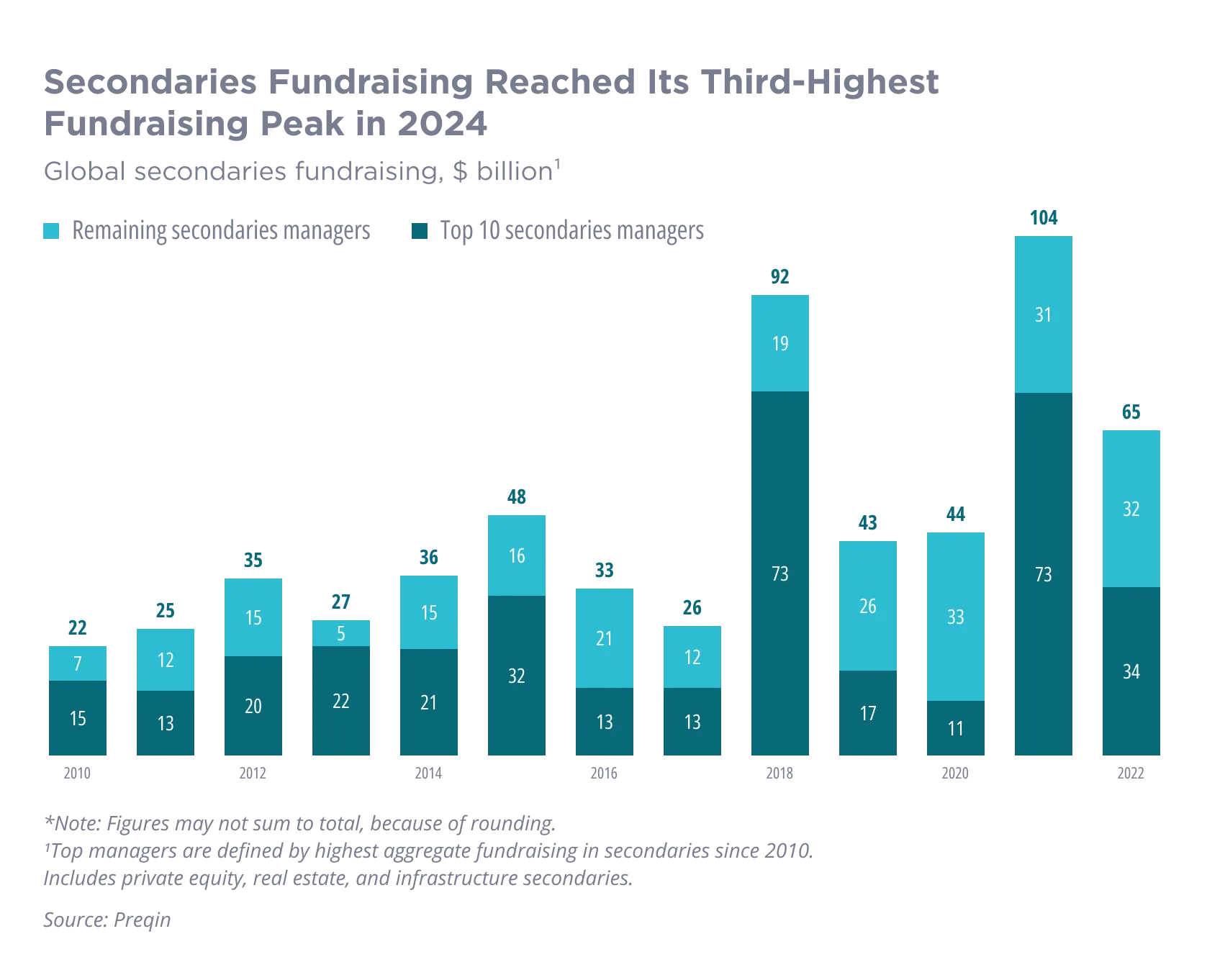
Secondaries fundraising has expanded significantly over the past decade, increasing from $17B in 2010 to a series of record years. The $65B raised in 2024, despite being below the $104B peak, reflects a market that has normalized rather than weakened. Institutions continue to allocate to secondaries for portfolio-level flexibility, portfolio construction benefits, and more predictable pacing, which has supported consistent capital formation across cycles.
The manager base has widened, with mid-sized and emerging firms capturing a growing share of commitments. Within this broader landscape, the Stableton Morningstar PitchBook Unicorn 20 offers a disciplined and scalable approach for accessing private blue-chip tech exposure.
THE UNTOLD UNICORN STORY
Revolut: From travel card to global financial super-app
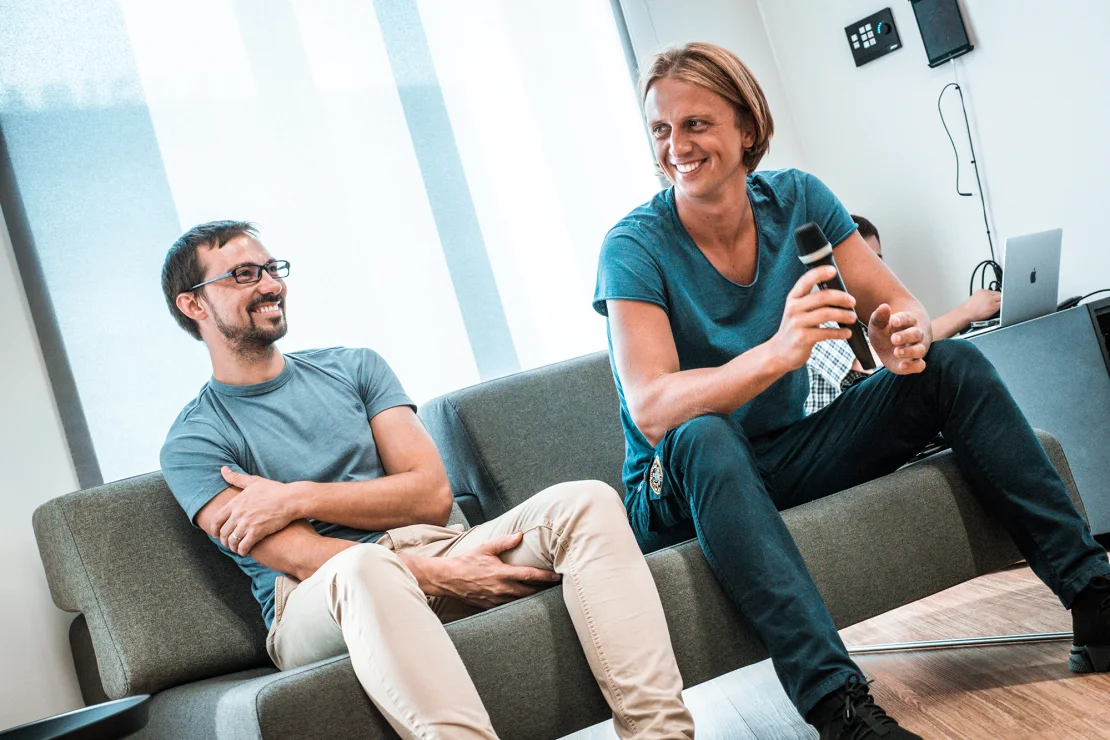
Revolut CEO Nik Storonsky (R) with co-founder Vlad Yatsenko (L). Source: CNN
Revolut's founding story centers on solving a personal frustration with international banking. In 2015, Nikolay Storonsky and Vlad Yatsenko launched the startup with a simple goal: eliminate hidden fees and poor exchange rates. Their MVP, a digital app linked to a payment card offering real-time currency conversion, quickly gained traction. By continuously iterating and adding features—like cryptocurrency trading—they expanded their user base and market reach. Today, Revolut stands as a fintech leader, valued at $48 billion, thanks to their agile approach and focus on user needs. (24)
Fun Fact: On top of his expertise in finance, Nikolay Storonsky also exhibited a strong aptitude for physics and economics from a young age. He earned a master's degree in General and Applied Physics from the Moscow Institute of Physics and Technology, followed by a master's in Applied Economics and Finance from the New Economic School in Moscow. (25)
Did you know? Revolut is one of the 20 companies in our Stableton Morningstar PitchBook Unicorn 20 strategy, a systematic, index-like approach that aims to outperform public benchmarks with low-cost fees, and without a performance fee. Click below for more information.
SOURCES
1 - Reuters, 2 - Bloomberg, 3 - Bloomberg, 4 - Anduril, 5 - MSN, 6 - Engadget, 7 - CNBC, 8 - Bloomberg, 9 - CRN, 10 - Epic Games, 11 - OpenAI, 12 - WIRED, 13 - The Economic Times, 14 - CNBC, 15 - Bloomberg, 16 - Android Headlines, 17 - Decrypt, 18 - TechCrunch, 19 - Payments Dive, 20 - Financial Times, 21 - NBC News, 22 - SAP News Center, 23 - Bloomberg, 24 - CNN, 25 - Fintech Magazine



Every Wednesday, the Navigator delivers a digest of news from our portfolio holdings and key trends shaping private tech investing. Subscribe to receive it directly in your inbox.


