




Anthropic Targets $900B Valuation, OpenAI Launches $10B PE Venture, Anduril Draws $624M Backing from Founders Fund
By Stableton on May 6th, 2026
From valuation expansion to deployment at scale, AI capital is accelerating. Anthropic nears $900B valuation, OpenAI builds a $10B distribution engine with private equity, and Anduril continues to draw capital to fund large-scale production. Let’s dive in…
THIS WEEK’S BREAKING NEWS
Anthropic approaches $900B valuation with new funding talks
Anthropic is in discussions to raise capital at a $900B valuation, potentially surpassing OpenAI’s recent $852B benchmark. The push is driven by rapid growth, including $30B annualized revenue and large-scale compute commitments such as 5GW agreements with Amazon and Google, supporting advanced models like Mythos. (1)
STABLETON MORNINGSTAR PITCHBOOK UNICORN 20 STRATEGY

The Stableton Morningstar PitchBook Unicorn 20 strategy is the world’s first passive, systematic, and semi-liquid approach to investing in the Top 20 privately held tech companies before they go public.
This strategy offers a straightforward and cost-effective way to gain exposure to leading private technology companies within a single portfolio. With no performance fees and enhanced liquidity, it offers a unique alternative to traditional private market investments.
STABLETON NEWS
Read the Q1 2026 report on private tech
Q1 2026 was a historic quarter for private markets. SpaceX filed for what could be the largest IPO in history (2), AI investment as a share of GDP surpassed every prior technology cycle (3), and the global secondary market continued to grow with volumes on pace to exceed $250 billion (4).
The latest Stableton Private Blue-Chip Tech Navigator breaks down the developments that defined the first quarter of 2026. It covers market conditions, major funding rounds, valuation shifts, and liquidity trends, alongside data on the Stableton Morningstar PitchBook Unicorn 20 strategy.
As private tech matures into an institutional asset class, we prioritize keeping you updated on the data behind all the major shifts. We put this report together so you can see exactly where the market stands and where it’s heading.
View the full Q1 2026 report below.
PORTFOLIO NEWS
Founders Fund set to invest $624M more into Anduril
Founders Fund is set to invest about $624M in Anduril’s proposed ~$4B funding round at a $60B valuation, bringing its total commitment to ~$2.6B if completed. The round is not yet finalized, while Anduril projects $4.3B revenue but continued $1B+ annual losses as it scales a capital-intensive defense manufacturing model. (5)
Anduril scales logistics footprint across Orange County
Anduril signed a 177,766-square-foot industrial lease in Tustin to establish a centralized logistics hub supporting its Orange County operations, where it now occupies nearly 1.5 million square feet. The move aligns with broader expansion plans, including a $2B, 5 million-square-foot Ohio facility and a $1B Long Beach campus, as valuation discussions approach $60B. (6)
Anduril deploys 5G connectivity into autonomous defense systems
Anduril introduced its 5G Comms Sentry Tower (CST), a deployable private 5G system designed for austere environments lacking infrastructure. Developed with Nokia Federal Solutions, CST delivers high-throughput connectivity within hours, supports multi-kilometer coverage, and operates independently of external power, extending Anduril’s Sentry platform, which already exceeds 400 deployed towers globally. (7)
Anthropic targets PE portfolios with $1.5B AI push
Anthropic is partnering with Goldman Sachs, Blackstone, and others to launch a $1.5B AI venture targeting private equity-backed companies. The initiative embeds engineers to deploy Claude AI directly into operations, addressing a key bottleneck in enterprise adoption, implementation talent, while using portfolio companies as scaled distribution channels for real-world AI integration. (8)
Tencent leveraging Anthropic models for Hy3 benchmarking and development
Anthropic’s Claude models were used by Tencent to benchmark and refine its Hy3 system despite restricted access in China. The case highlights Claude’s role as a global reference standard in post-training workflows, exposing enforcement gaps while reinforcing how leading AI models influence development cycles beyond direct commercialization channels. (9)
AI agents in bank workflows: Anthropic teams with FIS for financial crime detection
Anthropic partnered with Fidelity National Information Services (FIS) to build AI agents for banks, starting with financial crime detection tools. The system will autonomously aggregate transaction and account data to support investigations, reducing costs and processing time. Early adopters include Bank of Montreal and Amalgamated Bank, with broader rollout expected later this year. (10)
Anthropic looks to Fractile for next-gen inference chips
Anthropic is in early talks with U.K. startup Fractile to secure inference chips as surging demand strains its compute capacity. The move complements existing supply from Google, Amazon, and Nvidia, as Anthropic seeks to reduce costs and diversify suppliers amid projected tens of billions in annual infrastructure spending. (11)
Applied Intuition scales autonomy beyond large mining sites with Heidelberg Materials
Applied Intuition is collaborating with Heidelberg Materials to deploy autonomous haulage systems in quarry operations, starting in Australia. Its Self-Driving System enables infrastructure-light autonomy across both large and small sites, expanding beyond traditional high-capex deployments and positioning its platform for scalable, multi-site adoption across construction and mining environments globally. (12)
UiPath and Databricks integrate data intelligence with automation
UiPath and Databricks are introducing integrations that combine enterprise data intelligence with agentic automation. The solution enables real-time access to unified data, orchestrates AI agents through UiPath Maestro, and embeds governance across workflows, positioning both platforms to accelerate enterprise AI adoption with scalable, controlled, and data-driven operational decision-making. (13)
Epic launches store in Japan; Apple grip remains
Epic Games launched its app store on iPhone in Japan following new regulation, offering a 12% commission versus Apple’s traditional 30% fee. Despite this, no third-party developers have joined, citing retaliation risks and Apple’s 5% Core Technology Fee, which raises effective costs to ~17%, highlighting structural barriers to alternative app distribution. (14)
Figure AI scales to hourly robot output, boosts AI production
Figure AI scaled production of its Figure 03 robots from one unit per day to one per hour in under four months, surpassing 350 units via its BotQ facility. The ramp, supported by 150+ workstations and >80% yield, enables rapid data collection to enhance its Helix AI model, while new perception-driven control advances autonomous navigation without task-specific programming. (15)
OpenAI launches $10B PE-backed AI deployment venture
OpenAI has finalized a joint venture, The Deployment Company, targeting up to $10B, with over $4B already raised from 19 investors, including TPG, Brookfield Asset Management, Advent, and Bain Capital. The initiative focuses on accelerating enterprise AI adoption through private equity-backed distribution and implementation. (16)
Daloopa integrates with Perplexity to power AI research workflows
Daloopa partners with Perplexity AI to embed its structured, audit-ready financial data directly into AI research workflows via a bring-your-own-license model. Covering 5,500+ companies with traceable datapoints, the integration enables investment teams to run analysis within a single interface, addressing a key bottleneck in enterprise AI: reliable data access. (17)
Ramp launches AI agents to run end-to-end procurement
Ramp launched a fleet of AI agents across its procurement platform, automating sourcing, vendor selection, compliance checks, and contract analysis. Leveraging pricing data from millions of transactions, the system enables companies to achieve ~16% cost savings and reduce manual workload by 46 hours monthly, positioning Ramp to move from spend management into end-to-end procurement execution. (18)
Revolut opens Barcelona store to build trust beyond app
Revolut plans to open its first physical store in Barcelona, marking a shift beyond its digital-only model to build customer trust and brand presence. The move comes as revenue grew 46% and its loan book expanded 120%, supporting broader banking ambitions and a potential $200B IPO, while targeting 100 million users by 2027. (19)
Nasdaq reshapes IPO rules to boost SpaceX liquidity
Nasdaq recently introduced rule changes eliminating minimum float requirements and enabling rapid index inclusion, benefiting potential IPOs like SpaceX. With a projected $75B float at a $1.75T valuation, index funds could be forced to buy up to $3.1B initially, rising to $23.8B as float expands, effectively creating significant early liquidity and price support. (20)
Stripe brings USDC payouts into Meta’s creator economy
Meta introduced USDC payouts for creators, leveraging Stripe as the core infrastructure provider to enable wallet-based payments on Solana and Polygon. Initially launched in Colombia and the Philippines, the system taps into a $77B stablecoin ecosystem, signaling a shift toward integrating crypto rails into global payment workflows. (21)
Stripe Projects enables instant app setup with Algolia
Algolia integrated with Stripe Projects to streamline application development through a unified, terminal-based workflow. Developers can provision search infrastructure, manage credentials, and deploy production-ready applications within minutes, eliminating manual setup and enabling agent-assisted workflows that accelerate time-to-market while maintaining scalability and control. (22)
Mastercard and Stripe power agentic shopping with Wizard
Mastercard and Stripe partnered with Wizard to enable agentic commerce using Insight Tokens and Agent Pay via Stripe infrastructure. The integration allows AI agents to personalize discovery using spending data and complete transactions securely, as adoption grows with 43% of retailers piloting autonomous AI and 45% of consumers open to agent-led purchases. (23)
xAI drops Grok 4.3, combining pricing cuts and agents
xAI released Grok 4.3, cutting input costs by ~40% and output costs by ~60% while delivering a one-million-token context and 100 tokens/second speed. The model scored 53 on the Intelligence Index and improved to 1,500 Elo on GDPval-AA, though it still trails leading models. The release also introduces an agent-based creative mode for multi-step content generation. (24)
OTHER NEWS
Apptronik hires Waymo, Boston Dynamics talent to scale robotics development
Apptronik strengthened its leadership team with senior hires from Waymo, Boston Dynamics, and Amazon following a $935M Series A at a $5.3B valuation. The move signals a shift toward scaling productization and operations, as the company also teased a new humanoid robot amid intensifying competition in industrial deployment. (25)
ByteDance joins Time AI list with 100M user scale
ByteDance, alongside Alibaba and Zhipu AI, was named to Time’s first AI A-list, competing with U.S. leaders like OpenAI and Anthropic. ByteDance stands out for scaling consumer AI, with its Doubao assistant reaching 100M daily users, highlighting a divergence toward mass adoption versus infrastructure-led U.S. strategies. (26)
ByteDance drives demand shift toward Huawei AI chips after V4
ByteDance is among the leading firms driving a surge in demand for Huawei’s Ascend 950 AI chips following DeepSeek’s V4 model launch. As ByteDance moves to secure supply, alongside peers, the shift underscores growing reliance on domestic compute infrastructure amid export constraints and rising large-scale inference demand. (27)
Cerebras eyes $3.5B IPO at $26.6B valuation
Cerebras plans to raise up to $3.5B in a Nasdaq IPO, targeting a valuation of $26.6B. The offering follows 76% revenue growth to $510M and a strategic shift toward AI cloud services, including a $20B compute deal with OpenAI, positioning Cerebras as an alternative to Nvidia GPUs. (28)
Mistral pushes European open-source model with Medium 3.5
Mistral released Medium 3.5, a 128B-parameter model with agentic features, scoring 77.6% on SWE-Bench but facing criticism for pricing at $1.50/$7.50 per million tokens versus cheaper, higher-ranked Chinese rivals like Alibaba. Its differentiation lies in being a GDPR-compliant, self-hostable European alternative for enterprise and government use cases. (29)
Shield AI expands Asia presence with new Delhi office
Shield AI expanded in India by opening a New Delhi office and establishing a local subsidiary to support autonomy development and software integration for military programs. The move builds on partnerships with JSW Defence and follows India’s selection of its V-BAT drones, reinforcing long-term localization and capability building in a key strategic market. (30)
CHART OF THE WEEK
IPO scale has shifted to a new order of magnitude
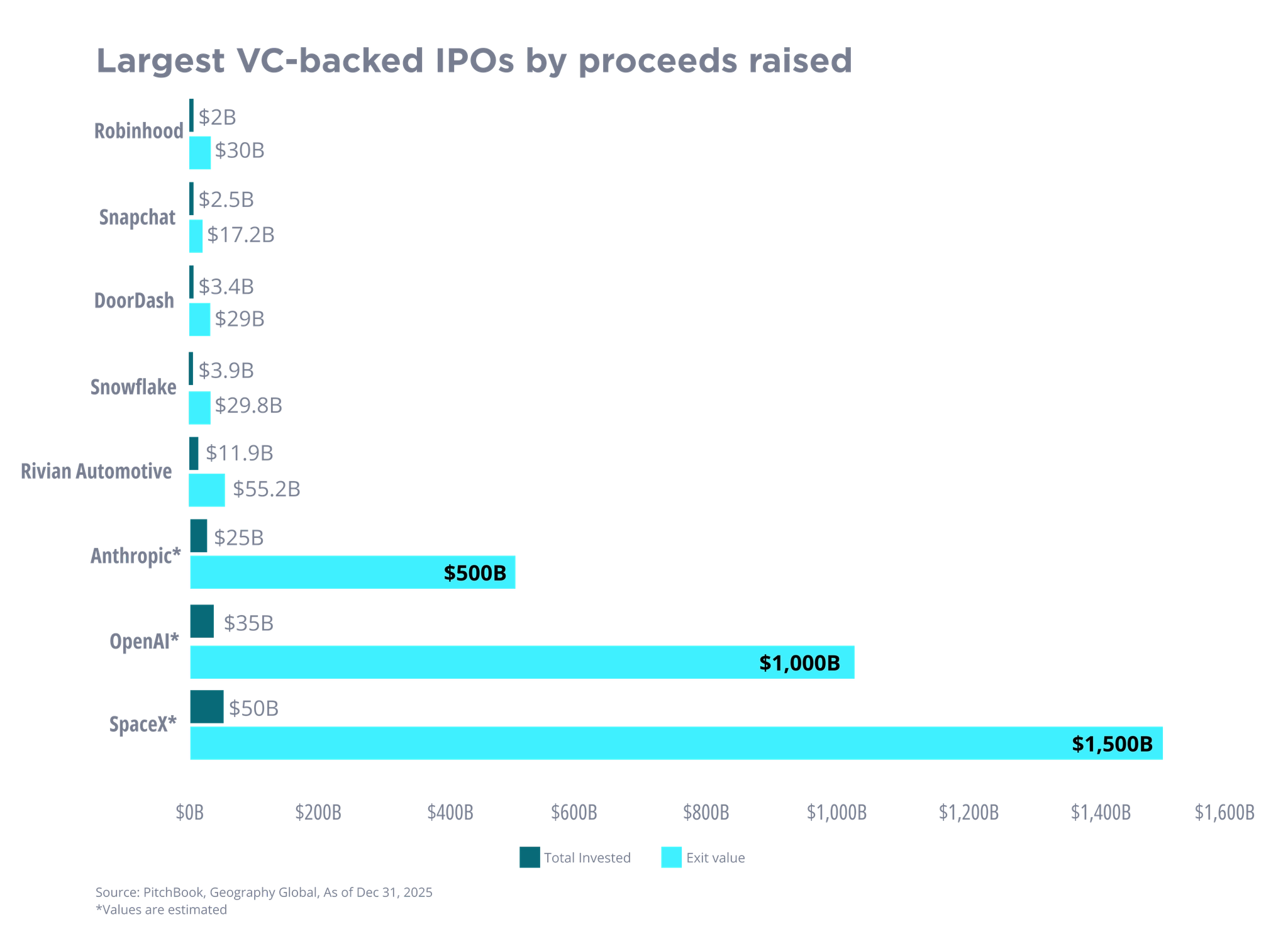
The largest VC-backed IPOs historically clustered in the $2B to $12B proceeds range, with companies like Snowflake, DoorDash, and Rivian defining the upper bound of venture-backed exits. These transactions set the benchmark for how private value transitioned into public markets over the past decade.
A new class of companies is now emerging at a different scale. Estimated listings from SpaceX, OpenAI, and Anthropic imply proceeds of $25B to $50B and potential valuations between $500B and $1.5T. This represents an expansion in both capital formation, where a handful of companies will dominate liquidity events and reshape index-level outcomes.
For institutional investors, banks, wealth managers, and family offices already positioned in these late-stage leaders, this shift is less about timing the IPO and more about participating in value creation ahead of it. This is where strategies like the Stableton Morningstar PitchBook Unicorn 20 strategy are aligned, focusing on the companies that are defining the next generation of public market scale. capital.
THE UNTOLD UNICORN STORY
Databricks: The long road from open source to $134 billion
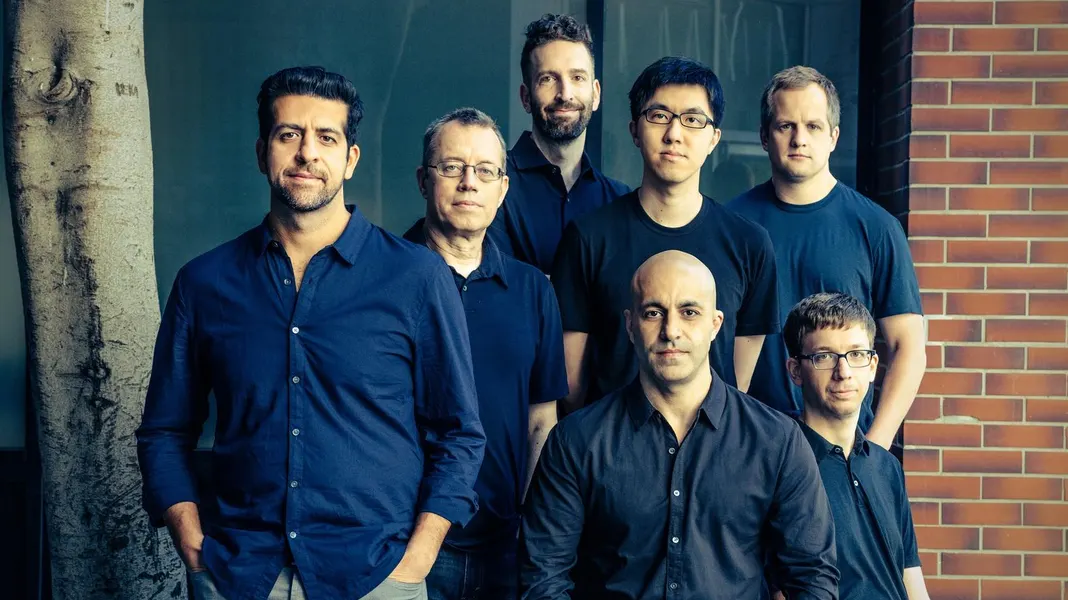 Databricks' 7 cofounders. Standing, from left: Arsalan Tavakoli, Ion Stoica, Andy Konwinski, Reynold Xin, Patrick Wendell. Sitting, from left: Ali Ghodsi, Matei Zaharia. (31)
Databricks began with seven UC Berkeley researchers and a hard lesson about turning research into revenue. In 2009, PhD student Matei Zaharia began developing Apache Spark, an open-source engine for processing massive datasets. Spark itself spread rapidly through the developer community, but the founders saw that enterprises needed a managed platform to deploy it without wrestling with the infrastructure themselves. So in 2013, the seven of them founded Databricks. (32)
Venture capitalist Ben Horowitz believed a hundred-billion-dollar company could be built on the technology, and Andreessen Horowitz led a $13.9 million Series A in September 2013 (33). But commercial traction was slow; Databricks had only about $1 million in revenue going into a later funding round. In January 2016, Ali Ghodsi took over as CEO and pivoted hard to enterprise sales (34). A decade later, Databricks is valued at $134 billion with a $5.4 billion revenue run rate growing 65% YoY, making it one of the most valuable private enterprise software companies in the world (35).
Fun Fact: In 2014, Databricks set a world record by sorting 100 terabytes of data in 23 minutes using 206 machines. The previous record, held by Yahoo, took 72 minutes on 2,100 machines.
Did you know? Databricks is one of the 20 companies in our Stableton Morningstar PitchBook Unicorn 20 strategy, a systematic, index approach that aims to outperform public benchmarks with low-cost fees, and without a performance fee. Click below for more information.
SOURCES
1 - CNBC, 2 - Financial Times, 3 - NBC, 4 - William Blair, 5 - The Information, 6 - OCBJ, 7 - Anduril, 8 - CNBC, 9 - The Information, 10 - Wall Street Journal, 11 - The Information, 12 - International Mining, 13 - Future CIO, 14 - TechSpot, 15 - The AI Insider, 16 - Bloomberg, 17 - PR Newswire, 18 - PR Newswire, 19 - Euronews, 20 - Financial Times, 21 - Decrypt, 22 - BusinessWire, 23 - PYMNTS, 24 - The Decoder, 25 - Forbes, 26 - South China Morning Post, 27 - Reuters, 28 - CNBC, 29 - Decrypt, 30 - The Defense Post, 31 - Forbes, 32 - Contrary Research, 33 - Reuters, 34 - Growfers, 35 - CNBC



Every Wednesday, the Navigator delivers a digest of news from our portfolio holdings and key trends shaping private tech investing. Subscribe to receive it directly in your inbox.


