




SpaceX Goes Public at $1.96T Valuation, OpenAI Reveals $34B Spend, Ripple Targets $1B Revenue
By Stableton on June 17th, 2026
Private market leaders are moving closer to public markets. SpaceX targets a $1.77T IPO, OpenAI takes its first formal step toward a Wall Street listing, and Ramp reaches a $44B valuation as AI-driven financial software continues to attract investor capital. Let’s dive in…
THIS WEEK’S BREAKING NEWS
SpaceX IPO values company at nearly $2T valuation
SpaceX debuted on public markets after a $75B IPO, opening at $150 per share and closing at $159, valuing the company at approximately $1.96T. The offering was reportedly four times oversubscribed, making SpaceX the sixth-largest U.S. company by market capitalization. The listing elevated Elon Musk to the world’s first trillionaire and is expected to serve as a benchmark for upcoming IPOs from leading AI companies. (1)
MARKET UPDATE
Mega IPOs pressure established index frameworks
SpaceX’s IPO is reigniting debate over how major equity indexes should handle mega-cap listings, particularly as upcoming offerings from AI leaders could reshape benchmark composition. While Nasdaq moved quickly to include SpaceX in the Nasdaq 100, the S&P 500 held back, highlighting differing approaches to balancing market representation and risk. Investors and index providers increasingly face questions around valuation, volatility, and whether fast-tracked IPOs should gain immediate inclusion in widely followed indexes. (2)
STABLETON MORNINGSTAR PITCHBOOK UNICORN 20 STRATEGY
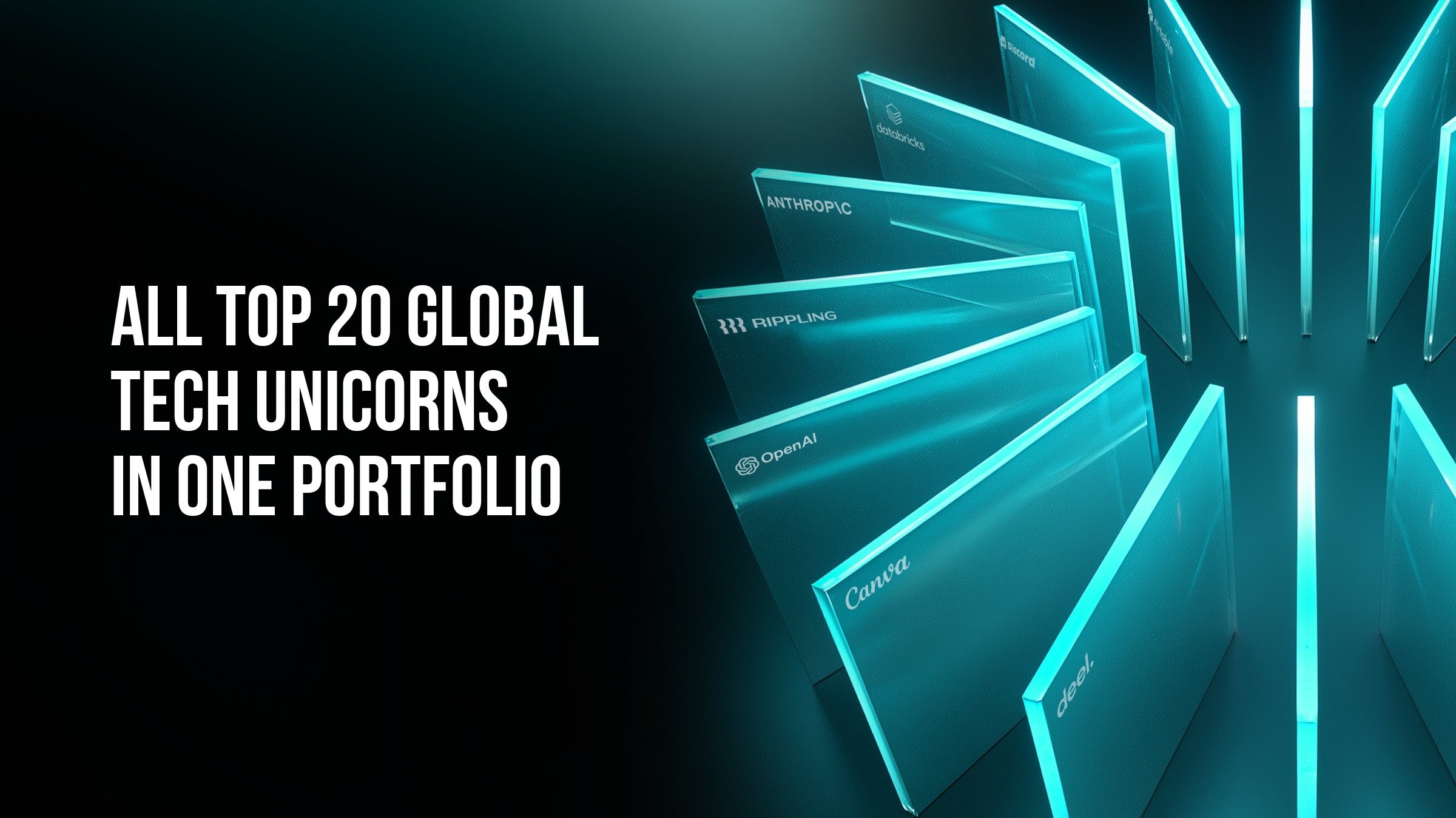
The Stableton Morningstar PitchBook Unicorn 20 strategy is the world’s first passive, systematic, and semi-liquid approach to investing in the Top 20 privately held tech companies before they go public.
This strategy offers a straightforward and cost-effective way to gain exposure to leading private technology companies within a single portfolio. With no performance fees and enhanced liquidity, it offers a unique alternative to traditional private market investments.
STABLETON NEWS
Read the Q1 2026 report on private tech
Q1 2026 was a historic quarter for private markets. SpaceX launched what became the largest IPO in history (2), AI investment as a share of GDP surpassed every prior technology cycle (3), and the global secondary market continued to grow with volumes on pace to exceed $250 billion (4).
The latest Stableton Private Blue-Chip Tech Navigator breaks down the developments that defined the first quarter of 2026. It covers market conditions, major funding rounds, valuation shifts, and liquidity trends, alongside data on the Stableton Morningstar PitchBook Unicorn 20 strategy.
As private tech matures into an institutional asset class, we prioritize keeping you updated on the data behind all the major shifts. We put this report together so you can see exactly where the market stands and where it’s heading.
View the full Q1 2026 report below.
PORTFOLIO NEWS
Anduril wins $363M CBP border security contract for autonomous systems deployment
Anduril secured a $363M contract from U.S. Customs and Border Protection to deploy more than 200 Extended Range Sentry Towers (XRSTs) across the Southwest Border. Building on a seven-year partnership, the autonomous towers can detect, classify, and track activity at distances exceeding five miles, complementing over 350 existing Sentry systems that have already identified hundreds of thousands of border crossings. The award highlights the growing role of autonomy in force multiplication, persistent surveillance, and large-scale border security operations. (6)
Anduril signals potential weapons manufacturing hub outside of U.S.
Anduril CEO Brian Schimpf said the company would consider locating its next weapons manufacturing hub outside the United States, highlighting Europe's deep pool of manufacturing talent. The comments suggest Anduril is evaluating a broader industrial footprint as it scales production capacity, reflecting growing demand for defense manufacturing across allied markets and the increasing globalization of defense technology supply chains. (7)
Anduril pushes U.S. arms export reforms for allied production
Anduril CEO Brian Schimpf called for a modernization of U.S. arms export controls, arguing that allied nations should play a larger role in manufacturing American-designed weapons to strengthen Western production capacity. The company is exploring European manufacturing, building its Ohio-based Arsenal-1 facility, and expanding partnerships such as Rheinmetall. The push comes as Anduril scales rapidly, reaching $2.2B in 2025 revenue, projecting over $4.3B this year, and securing a $61B valuation. (8)
Anthropic halts flagship Fable and Mythos global access amid cybersecurity concerns
Anthropic shut down access to its newest Fable 5 and Mythos 5 AI models after the Trump administration imposed export restrictions prohibiting use by foreign governments, companies, individuals, and foreign nationals in the U.S. The move disrupts cybersecurity deployments across sectors including finance and energy, intensifies tensions between Anthropic and Washington, and marks one of the most significant government interventions in the commercialization of advanced AI models to date. (9)
TRATON scales software-defined vehicle strategy with Applied Intuition
TRATON and Applied Intuition developed the foundation of TRATON ONE OS at an unusually rapid pace, onboarding nearly 200 engineers and progressing from a system demonstration to prototype trucks in testing within months. The partnership combines TRATON’s commercial vehicle expertise with Applied Intuition’s software platform, using shared source code access, joint engineering ownership, and a flat decision-making structure to accelerate development of a unified operating system for all TRATON brands. (10)
Cursor opens London hub; expands EMEA footprint amid SpaceX interest
Cursor is expanding internationally with a new London headquarters and plans to hire 200 employees across EMEA as European revenue triples quarter-over-quarter in 2026. The company serves more than 67% of Fortune 500 firms, generates 150 million lines of enterprise code daily, and reached $2B in annualized revenue in February. The expansion comes as SpaceX holds an option to acquire Cursor’s parent company, Anysphere, for $60B later this year. (11)
Hyundai partners with Epic Games for World Cup campaign strategy
Hyundai Motor is expanding its FIFA World Cup 2026™ campaign into gaming through a collaboration with Epic Games, bringing the IONIQ 6 N Line into Rocket League and Fortnite via limited-time events. Players can unlock branded vehicles and rewards through gameplay, while Hyundai will host a dedicated Rocket League tournament featuring creators and professional players. The initiative positions Hyundai as the only automotive brand participating in the activations, extending its World Cup sponsorship into digital engagement channels. (12)
FIFA names Kraken as official crypto exchange partner of the 2026 FIFA World Cup
Kraken was named the official crypto exchange of the 2026 FIFA World Cup, leveraging the tournament’s global audience to promote cryptocurrency adoption and position digital assets alongside mainstream sports. The partnership aligns FIFA’s focus on technology-driven fan engagement with Kraken’s vision of an open financial system, while highlighting the growing convergence of sports, digital finance, and blockchain-based consumer experiences. (13)
Kraken launches CFTC-regulated perpetual futures offering
Kraken launched perpetual futures for eligible U.S. clients, bringing one of crypto’s most widely traded derivatives products onshore through its CFTC-regulated Bitnomial platform. Perpetual futures generated more than $60T in trading volume in 2025, yet have historically been unavailable in the U.S. The launch allows traders to manage spot, margin, futures, and perpetual positions within a single account and collateral pool, improving capital efficiency and reducing operational complexity. (14)
Samsung secures first chip manufacturing contract for Neuralink
Samsung Foundry has reportedly secured its first chip manufacturing order from Neuralink, expanding its relationship with Elon Musk’s ecosystem following last year’s $16.5 billion Tesla AI6 chip contract. The fourth-generation Neuralink processor, reportedly being developed on Samsung’s 4-nanometer process, is designed for brain-computer interface systems, with initial test production already underway and commercial manufacturing targeted for 2027. The deal further broadens Samsung’s position in advanced AI and neurotechnology semiconductor manufacturing. (15)
OpenAI reveals $34B annual spending ahead of planned IPO
OpenAI spent approximately $34B in 2025, including $19B on R&D and nearly $6B on sales and marketing, as it accelerated model development, infrastructure investment, and talent acquisition ahead of a planned IPO. The company generated $13B in revenue and reached $2B in monthly revenue by year-end, but reported a $39B net loss, largely driven by a one-time $30B accounting charge related to its prior corporate structure. (16)
OpenAI launches $150M enterprise partner network
OpenAI launched the OpenAI Partner Network, a global ecosystem designed to help enterprises deploy AI at scale through consulting, systems integration, technology, and data partners. The company is committing $150M to support the program and aims to train 300,000 certified consultants by the end of 2026. The initiative reflects OpenAI’s view that enterprise AI adoption now depends less on model capabilities and more on implementation, workflow redesign, systems integration, governance, and organizational change management. (17)
OpenAI and Visa launch agentic commerce partnership
OpenAI and Visa are expanding their partnership to enable AI agents to complete online purchases on behalf of users once authorization has been granted. By integrating Visa’s payment infrastructure into OpenAI’s platform, merchants will be able to accept agent-driven transactions ranging from bill payments to retail purchases. The collaboration also extends to enterprise applications, positioning AI agents as active participants in digital commerce and accelerating the development of agentic payment systems. (18)
Perplexity challenges Amazon over Comet shopping assistant
Perplexity is challenging a preliminary injunction that restricts its Comet AI shopping assistant from accessing Amazon on behalf of users, arguing the tool functions like a browser rather than an unauthorized system. Amazon contends Comet’s autonomous capabilities and access to user account data exceed traditional browsing behavior and violate computer access laws. The case, involving a $21B-valued Perplexity, could set an important precedent for how AI agents interact with online platforms and user accounts. (19)
Revolut expands banking push with 5% savings offer for UK customers
Revolut has launched a promotional 5% AER savings rate for new UK customers, available on Instant Access Savings accounts opened between 5 June and 4 August 2026. The offer applies to balances up to £25,000, with interest calculated and paid daily and no minimum deposit or withdrawal restrictions. The initiative strengthens Revolut’s push into consumer banking while using savings products to attract new customers and deepen engagement within its UK ecosystem. (20)
Ripple expands stablecoin strategy into agentic commerce
Ripple has launched the XRPL AI Starter Kit, enabling developers to build agentic payment applications on the XRP Ledger using XRP and RLUSD. The move positions Ripple within the rapidly emerging market for AI-driven commerce, where Visa, Mastercard, Stripe, Coinbase, and others are developing competing solutions. By combining stablecoin settlement, asset conversion, and autonomous transaction execution, Ripple aims to expand the utility of its blockchain infrastructure beyond cross-border payments and into machine-to-machine commerce. (21)
Ripple targets $1B revenue as infrastructure expands
Ripple is targeting a $1B annualized revenue run rate by the end of 2026, with CEO Brad Garlinghouse emphasizing that the goal excludes any contribution from XRP held on the company’s balance sheet. Growth is expected to be driven by the $1.25B Hidden Road acquisition, expansion of the RLUSD stablecoin, and new AI-powered payment infrastructure, reflecting Ripple’s evolution into a broader financial infrastructure provider serving institutional clients. (22)
SpaceX trades higher on revenue growth outlook
SpaceX shares rose another 10% in premarket trading after gaining 20% in their first full trading session, extending momentum following the company’s record IPO. Investor enthusiasm was fueled by Elon Musk’s projection that SpaceX could reach $1T in revenue by 2030, up from $18.7B in 2025. The rally comes despite growing debate over whether the company’s valuation can be justified by future growth expectations. (23)
Stripe moves global product leadership to Singapore
Stripe is relocating its Head of Global Product, Abhinav Tiwari, to Singapore as it deepens its Asia-Pacific expansion and targets growth in complex regional payment markets. The company is developing new products with partners such as GCash and sees significant opportunities in cross-border payments and stablecoins. Stripe is also participating in Singapore’s Project Bloom initiative as it seeks to advance stablecoin-based settlement infrastructure in the region. (24)
OTHER NEWS
ByteDance eyes 50,000-chip deal with Iluvatar
ByteDance is reportedly negotiating to purchase at least 50,000 AI chips from Iluvatar CoreX for inference workloads while also evaluating Baidu’s Kunlunxin processors. If completed, Iluvatar would become ByteDance’s third major domestic GPU supplier alongside Huawei and Cambricon. The discussions underscore China's accelerating shift toward local AI infrastructure, with domestic chipmakers capturing nearly 41% of China’s AI accelerator server market as companies seek alternatives to foreign hardware amid U.S. export restrictions. (25)
Lovable surpasses $500M as AI software creation accelerates
Lovable reported $500M in annualized revenue and is now powering more than 1 million new projects per week, with over 50 million projects created on the platform. The company says many users are non-technical founders and business operators building internal software, e-commerce tools, and business applications, highlighting growing adoption of AI-driven software development beyond traditional engineering teams. (26)
Mistral targets €20B valuation in new funding for Europe’s AI ambitions
Mistral AI is reportedly in discussions to raise approximately €3B at a €20B valuation, nearly doubling its valuation from €11.7B in less than a year. The company is positioning itself as Europe’s AI infrastructure champion, supplying governments, banks, and industrial firms, including Airbus and BMW, while investing in sovereign cloud infrastructure and cybersecurity-focused AI capabilities to compete with larger U.S. and Chinese rivals. (27)
Shield AI advances autonomous warfare with Destinus
Shield AI and Destinus demonstrated autonomous strike and teaming capabilities on the Hornet interceptor platform, validating Shield AI’s Hivemind AI pilot in a full-mission flight exercise in Spain. The test included autonomous terrain following, in-flight target updates, and terminal maneuver execution, advancing a broader effort to deploy coordinated autonomous systems in contested environments. The companies plan to transition the capability to the Ruta strike platform in Ukraine, enabling multi-platform autonomous operations against unmanned threats at scale. (28)
Megaport selects VAST Data for AI infrastructure expansion and development
Megaport has selected VAST Data’s AI Operating System as the data layer underpinning its expanding global infrastructure platform, following its acquisition of Latitude.sh and push into compute and GPU services. The partnership provides a unified data foundation across networking, compute, and AI workloads, enabling enterprises to deploy and scale AI applications across distributed, hybrid, and multicloud environments while reducing infrastructure fragmentation. (29)
CHART OF THE WEEK
Secondary market liquidity continues to accelerate
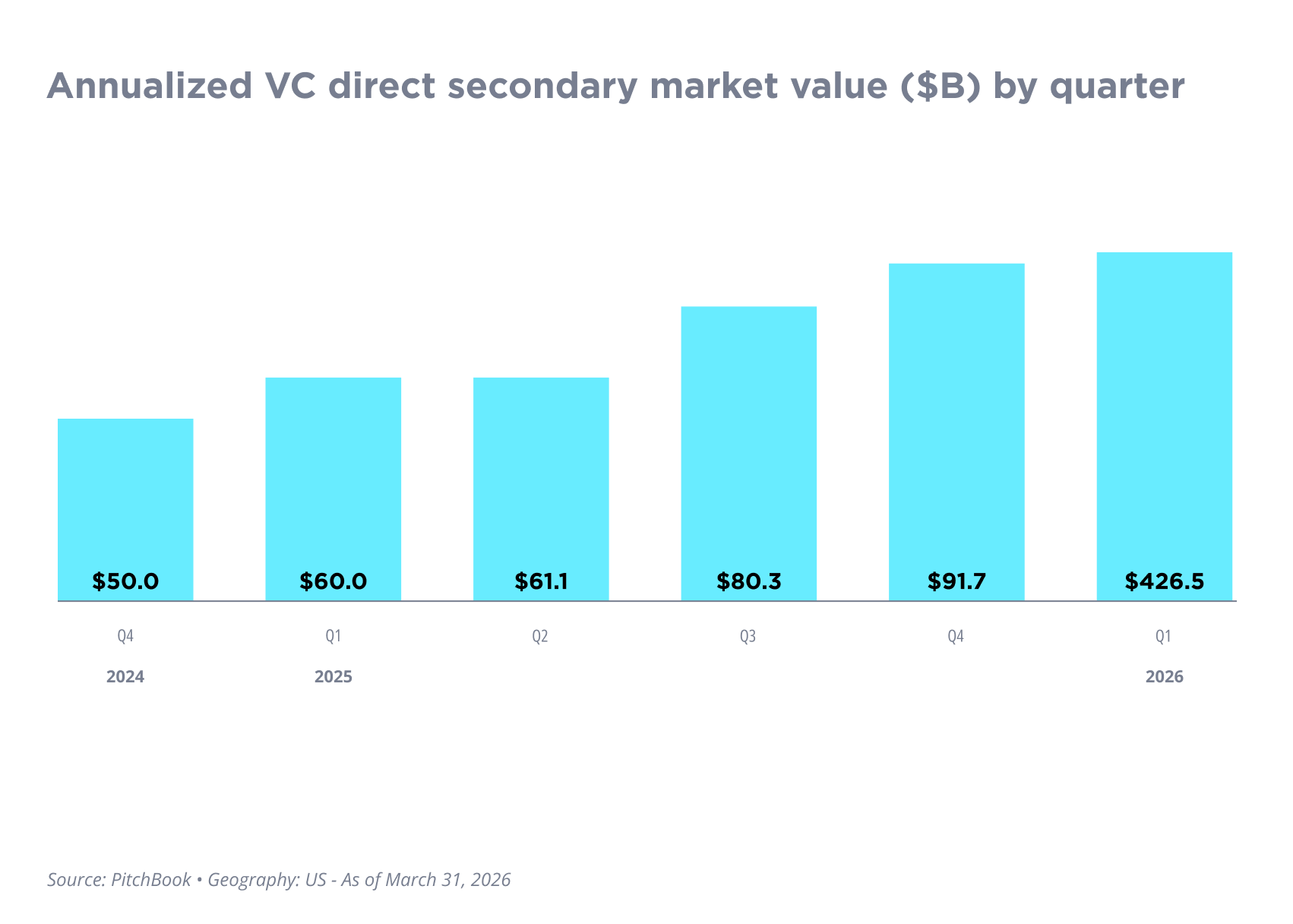
Direct secondary transaction volume has continued to climb sharply. This growth shows how private markets are adapting to a world where companies remain private longer and investors require more flexible liquidity solutions between funding rounds and IPOs. Rather than relying solely on public listings or acquisitions, shareholders are using secondaries to manage exposure and rebalance positions while companies continue compounding privately.
What stands out is the consistency of this expansion. Secondary activity is no longer episodic or tied to stressed market conditions. It is becoming embedded into the normal operating system of markets. As institutional participation deepens, liquidity is concentrating around the largest and most actively traded technology leaders. The Stableton Morningstar PitchBook Unicorn 20 strategy is positioned within this environment, focusing on the private blue-chip tech companies driving the majority of secondary activity and absorbing the largest flows of institutional capital.
THE UNTOLD UNICORN STORY
Deel: Breaking borders, one paycheck at a time
 Alex Bouaziz and Shuo Wang, Founders of Deel. (30)
Deel almost didn't exist. One to two weeks before Y Combinator Demo Day in 2019, the company's original idea was failing. Alex Bouaziz and Shuo Wang had built an escrow platform to help freelancers get paid automatically upon completing work, but as Bouaziz later admitted, the concept wasn't resonating. In desperation, they pivoted, interviewed companies to uncover the real pain point, and discovered it: the nightmare of hiring and paying people across borders. They scrambled to Demo Day with 290 contractors and $5,000 in monthly revenue. (31)
Three weeks after closing their seed round, COVID hit, and the entire world went remote. Suddenly, every company needed what Deel was building. They grew from $1 million to $100 million in annual recurring revenue in just 20 months, making Deel one of the fastest-growing SaaS companies in history. Today, Deel is valued at $17.3 billion and powers payroll and HR for over 35,000 companies in 150+ countries. (32)
Fun Fact: Deel surpassed $1 billion in annual recurring revenue in Q1 2025, just over six years after launch. That's faster than Stripe, Salesforce, Palantir, and Square, and the company did it while being 100% remote with employees in over 100 countries. (33)
Did you know? Deel is one of the 20 companies in our Stableton Morningstar PitchBook Unicorn 20 strategy, a systematic, index approach that aims to outperform public benchmarks with low-cost fees, and without a performance fee. Click below for more information.
SOURCES
1 - Aljazeera, 2 - Business Standard, 3 - Financial Times, 4 - NBC, 5 - William Blair, 6 - Anduril, 7 - Bloomberg, 8 - Financial Times, 9 - The Wall Street Journal, 10 - Applied Intuition, 11 - Tech Funding News, 12 - Hyundai Motor Group, 13 - Forbes, 14 - Business Wire, 15 - KED Global, 16 - Financial Times, 17 - OpenAI, 18 - Bloomberg, 19 - Courthouse News Service, 20 - Fintech Global, 21 - American Banker, 22 - CCN, 23 - CNBC, 24 - The Business Times, 25 - Reuters, 26 - TechCrunch, 27 - Bloomberg, 28 - PR Newswire, 29 - IT Wire, 30 - INC., 31 - BackScoop, 32 - TechCrunch, 33 - Business Wire


Every Wednesday, the Navigator delivers a digest of news from our portfolio holdings and key trends shaping private tech investing. Subscribe to receive it directly in your inbox.


