




SpaceX Targets $1.77T IPO, OpenAI Files to Go Public, Ramp Hits $44B Valuation
By Stableton on June 10th, 2026
Private market leaders are moving closer to public markets. SpaceX targets a $1.77T IPO, OpenAI takes its first formal step toward a Wall Street listing, and Ramp reaches a $44B valuation as AI-driven financial software continues to attract investor capital. Let’s dive in…
THIS WEEK’S BREAKING NEWS
SpaceX targets $135 IPO price at $1.77T valuation in historic IPO
SpaceX has set its IPO price at $135 per share, targeting a $75B raise and an implied valuation of $1.77T, which would make it the seventh-largest publicly traded company in the U.S. The offering includes 555.6M shares, with underwriters able to purchase an additional $11.2B of stock. SpaceX is expected to begin trading on Nasdaq on June 12, positioning the company for what would become the largest IPO in history. (1)
STABLETON MORNINGSTAR PITCHBOOK UNICORN 20 STRATEGY

The Stableton Morningstar PitchBook Unicorn 20 strategy is the world’s first passive, systematic, and semi-liquid approach to investing in the Top 20 privately held tech companies before they go public.
This strategy offers a straightforward and cost-effective way to gain exposure to leading private technology companies within a single portfolio. With no performance fees and enhanced liquidity, it offers a unique alternative to traditional private market investments.
STABLETON NEWS
Read the Q1 2026 report on private tech

Q1 2026 was a historic quarter for private markets. SpaceX filed for what could be the largest IPO in history (2), AI investment as a share of GDP surpassed every prior technology cycle (3), and the global secondary market continued to grow with volumes on pace to exceed $250 billion (4).
The latest Stableton Private Blue-Chip Tech Navigator breaks down the developments that defined the first quarter of 2026. It covers market conditions, major funding rounds, valuation shifts, and liquidity trends, alongside data on the Stableton Morningstar PitchBook Unicorn 20 strategy.
As private tech matures into an institutional asset class, we prioritize keeping you updated on the data behind all the major shifts. We put this report together so you can see exactly where the market stands and where it’s heading.
View the full Q1 2026 report below.
PORTFOLIO NEWS
Anduril wins U.S. approval for $2B counter-drone sale to Kuwait
Anduril secured U.S. State Department approval for a potential $1.98B foreign military sale of counter-drone systems to Kuwait, days after an Iranian drone and missile attack disrupted Kuwait’s airport. The package includes Roadrunner interceptors, Sentry Towers, electromagnetic warfare systems, command-and-control infrastructure, training, and support. Kuwaiti defense experts view the purchase as a shift toward layered defenses designed to counter low-cost drone saturation attacks that can exploit gaps in traditional missile-based air defense networks. (5)
Anduril scales defense tech presence with Seattle expansion and 100+ hires
Anduril is deepening its presence in Seattle as it scales its connected warfare business, with more than 100 open roles and plans to expand its footprint in the city's 2+U office tower. The company, recently valued at $61B, is also investing millions of dollars to redevelop a former shipyard for autonomous naval vessel production in partnership with HD Hyundai, positioning the Pacific Northwest as a strategic hub for defense technology and shipbuilding. (6)
Anduril partners with Elbit for Army howitzer bid
Anduril and Elbit Systems of America collaborated for the U.S. Army’s Self-Propelled Howitzer Modernization program, combining Elbit’s SIGMA Mobile Tactical Cannon with Anduril’s autonomy, edge computing, and battlefield networking technologies. The proposal would integrate Anduril’s Lattice platform to enhance automation and digital connectivity. The program represents the Army’s latest effort to field a next-generation self-propelled howitzer capable of delivering mobile, survivable, and longer-range fire support through 2040 and beyond. (7)
Anthropic calls for coordinated AI development pause, cites self-improvement risks
Anthropic has called for leading AI labs to establish a coordinated mechanism to slow or temporarily pause development of advanced AI systems if capabilities begin advancing faster than safety measures can keep pace. The company cited the potential emergence of recursive self-improving AI and growing cybersecurity risks, including AI-powered self-adapting malware, while arguing that global coordination would help prevent less cautious actors from gaining an advantage during any slowdown. (8)
Anthropic brings Mythos to government cyber operations
Anthropic is reportedly working with the U.S. National Security Agency to deploy its Mythos AI model for cybersecurity applications, including embedding engineers within the agency to customize the technology for specific use cases. The collaboration comes amid an ongoing legal dispute with the Pentagon over military use of Anthropic’s models and follows the broader rollout of Mythos to 150 organizations across 15 countries, highlighting the growing intersection of advanced AI, cybersecurity, and national security priorities. (9)
Anthropic expands Mythos access to 15+ countries
Anthropic is expanding access to its Mythos cybersecurity model through Project Glasswing, increasing participation from roughly 50 organizations to 150 organizations across more than 15 countries. The initiative now includes critical infrastructure providers, financial market operators, technology companies, NATO, and government cybersecurity agencies. The expansion follows Anthropic’s IPO filing and reflects growing demand for advanced AI tools capable of identifying vulnerabilities in systems that support hundreds of millions of users globally. (10)
Anthropic lands $35B AI infrastructure financing package from Apollo and Blackstone
Anthropic has secured a $35B financing package from Apollo and Blackstone to expand its AI infrastructure using Google-designed TPUs, marking one of the largest private credit transactions ever completed. Broadcom is providing support for $30B of the senior debt, helping lower financing costs. The deal underscores Anthropic’s growing strategic importance and highlights how leading AI companies are increasingly tapping private credit markets to fund large-scale compute expansion. (11)
Cursor introduces centralized management for enterprise teams and AI governance
Cursor has launched Organizations for Enterprise customers, introducing a new management layer that enables companies to oversee multiple teams from a single dashboard. The structure allows administrators to set separate budgets, security policies, model access, and feature controls across departments while maintaining centralized identity management, analytics, and governance. The update is designed for large enterprises with multiple business units that require distinct operational controls without sacrificing company-wide visibility. (12)
Cursor tops $4B annualized revenue ahead of potential SpaceX acquisition
Cursor has surpassed $4B in annualized revenue, up from $3B in April and $2B in February, underscoring continued demand for AI-powered software development tools. The growth comes ahead of an expected acquisition by SpaceX and has been driven by expanding enterprise adoption, which now accounts for 75% of revenue, alongside strong uptake of Cursor’s Cloud Agents product launched earlier this year. (13)
Databricks explores funding round at $175B valuation
Databricks is reportedly exploring a new funding round that could value the company between $165B and $175B, up from its $134B valuation in late 2025. The discussions follow strong business momentum, including a $5.4B revenue run rate growing 65% year-over-year and more than $1.4B in AI-related revenue. Despite continued IPO speculation, the company appears positioned to remain private longer while raising additional growth capital. (14)
Databricks delays IPO amid wave of major tech listings
Ali Ghodsi said the company remains committed to becoming a public company but does not plan to pursue an IPO in 2026, citing a crowded market for large technology listings. The decision comes after Databricks raised more than $4B at a $134B valuation and secured $1.8B in financing earlier this year. Ghodsi pointed to upcoming offerings from SpaceX, Anthropic, and OpenAI as reasons to delay a public market debut. (15)
Deel launches DLUSD for global dollar payroll
Deel has launched DLUSD, a USD-backed stablecoin that allows its 1.5 million workers across 150 countries to hold, spend, and receive dollar-denominated payments directly within the Deel platform without requiring a U.S. bank account. The launch follows Mastercard’s expansion of stablecoin settlement capabilities across its global payments network. Together, the announcements highlight the growing adoption of stablecoins as payment and settlement infrastructure, supported by a market that reached $317B and processed an estimated $46T in transaction volume last year. (16)
Kraken and Bybit launch pre-IPO SpaceX trading via xStocks
Bybit and Kraken have launched tokenized SpaceX exposure through the xStocks framework, joining Coinbase International and BitMEX in offering pre-IPO SpaceX trading products. Unlike synthetic perpetual futures, xStocks tokens are backed 1:1 by underlying shares held in regulated custody and are designed to transition to post-IPO equity pricing. The development comes as SpaceX-related open interest across venues reaches $280M, highlighting growing demand for private company exposure through digital asset infrastructure. (17)
OpenAI files for blockbuster Wall Street listing at $1T valuation
OpenAI has confidentially filed for an IPO that could value the company at more than $1T, formally launching what may become one of the largest technology listings in history. The filing follows a record $122B funding round and comes as OpenAI scales infrastructure to support 900 million ChatGPT users while competing with Anthropic and Google. The company is also planning an employee share sale and could begin trading as early as this autumn. (18)
OpenAI and White House discuss potential U.S. government equity stake
OpenAI and the Trump administration are reportedly discussing a potential arrangement that could give the U.S. government an equity stake in the AI company as part of a broader public wealth fund concept. The discussions, which have been ongoing since 2025, come as OpenAI prepares for a potential IPO and deepen its engagement with policymakers on AI regulation, national security, and infrastructure. No formal terms have been agreed, and negotiations remain ongoing. (19)
OpenAI builds super app ahead of potential IPO
OpenAI is reportedly preparing its largest overhaul of ChatGPT since launch, transforming the product into a “super app” that integrates AI agents, coding tools such as Codex, and other services within a unified interface. The initiative is aimed at strengthening OpenAI’s position with enterprise customers, improving monetization ahead of a potential IPO, and creating a platform where AI can assist users across both personal and professional workflows. (20)
Perplexity unveils platform to optimize AI workloads across devices and cloud
Perplexity has introduced a platform that dynamically routes AI workloads between personal computers and cloud servers, aiming to reduce infrastructure costs and improve computing efficiency. Announced alongside Intel at Computex, the system determines which tasks can run locally and which require cloud resources. The strategy comes as Perplexity scales rapidly, with revenue reportedly increasing fivefold from $100M to $500M while headcount grew just 34%, highlighting a focus on efficient AI deployment. (21)
Ramp lands $750M funding round at $44B valuation
Ramp has raised $750M at a $44B valuation, nearly tripling its value within a year as investors back fintech platforms with credible AI strategies. The company serves more than 70,000 customers, has surpassed a $1B annualized revenue run rate, and reached positive free cash flow. Ramp is increasingly positioning itself as an AI-powered financial operations platform, offering tools for procurement, accounting, budgeting, and AI spend management as businesses seek greater control over rising AI-related costs. (22)
Ramp launches Stack for accounting firm automation
Ramp has launched Stack, an AI operating system for accounting firms, marking its expansion into a $150B industry facing significant labor shortages and rising client demands. Built with input from accounting firms, Stack automates workflows such as transaction coding, reconciliations, journal entries, and month-end close processes. Ramp says 92 of the top 100 CPA firms already have clients on its platform, while early users report reducing month-end close workloads by up to 50%. (23)
Revolut seeks up to $2B at potential $115B valuation in tender offer
Revolut is preparing a secondary share sale that could raise at least $750M and potentially as much as $2B, valuing the company at $109B, or $115B on a fully diluted basis. The proposed transaction would represent nearly a 50% increase from Revolut’s $75B valuation last year and could make it Europe’s first venture-backed company valued above $100B. The offering follows strong financial performance, including $6B in revenue and $2.3B in pre-tax profit in 2025. (24)
Revolut plans FDIC-insured banking and stablecoin services
Revolut’s planned U.S. bank is expected to offer FDIC-insured checking and high-yield accounts, alongside stablecoins, multi-currency deposits, stock trading, and cryptocurrency services. Following its U.S. national bank charter application in March, Revolut aims to launch operations next year, initially targeting internationally focused retail and business customers. The move expands the company’s U.S. ambitions as it seeks to leverage its global network of 75 million customers and multi-currency capabilities. (25)
Revolut deepens banking push with UK credit card launches
Revolut plans to launch five credit card products in the UK as it expands its lending and wealth management offerings following the receipt of its full UK banking license. The move supports the company’s strategy to grow interest income, which represented 22% of revenue in 2025, while broadening its product suite for its 75 million customers. Revolut is also exploring personal loans and sees significant opportunities in underserved segments of the wealth management market. (26)
Google signs $920M monthly AI infrastructure deal with SpaceX
Google has signed an agreement to pay SpaceX $920M per month for AI compute capacity through June 2029, using approximately 110,000 Nvidia GPUs housed in SpaceX data centers. The deal follows Anthropic’s earlier commitment to use capacity at SpaceX’s Colossus 1 facility and provides a major revenue stream ahead of SpaceX’s IPO. The agreement highlights SpaceX’s growing role as an AI infrastructure provider as hyperscalers race to secure compute capacity amid surging demand. (27)
xAI expands AI video capabilities with Grok Imagine 1.5
xAI has released Grok Imagine 1.5 Preview, its latest image-to-video model, making it available through the xAI API as the company expands its generative media capabilities. The model converts still images into short videos, supports native audio generation, and enables developers to build video applications directly on xAI’s platform. The launch broadens xAI’s product suite beyond chat and coding models as competition intensifies in AI-generated video. (28)
OTHER NEWS
ByteDance and Oracle purchase Arm data center CPUs
Arm disclosed that ByteDance and Oracle have purchased its AGI data center CPU, the company’s first self-developed server processor designed for agentic AI infrastructure. Demand for the chip has exceeded expectations, with Arm reporting more than $2B of demand across FY27 and FY28, more than double the level cited at launch. The strong uptake underscores growing adoption of Arm-based architectures in AI data centers and has reportedly created production bottlenecks across the supply chain. (29)
Cerebras pursues AI infrastructure partnerships beyond Nvidia
Cerebras is expanding its ecosystem strategy by pursuing partnerships across the AI infrastructure stack, with CEO Andrew Feldman stating the company is willing to work with virtually every industry participant except Nvidia. The move follows recent agreements with Amazon Web Services and OpenAI, as well as Cerebras’ public market debut. By combining its wafer-scale AI processors with third-party infrastructure, Cerebras is positioning itself as an alternative architecture for AI training and inference workloads. (30)
Airbus expands AI strategy through Mistral partnership
Airbus has entered a multi-year partnership with Mistral AI to deploy artificial intelligence across aircraft design, production automation, cybersecurity, and defense applications. The collaboration expands Airbus’s use of AI in both its commercial aviation and defense businesses, with a focus on improving engineering workflows, manufacturing processes, and digital security. The initiative reflects a broader industry shift toward integrating AI into complex aerospace and defense systems while maintaining regulatory and operational requirements. (31)
Kalshi and Polymarket restrict election misinformation claims
Prediction market platforms Kalshi and Polymarket have updated their affiliate policies to prohibit paid creators from denying election results or spreading election-related misinformation. Both companies have taken action against sponsored content tied to disputed claims about California’s recent election, including requests to remove posts or sponsorship disclosures. The move comes as prediction markets face increasing regulatory scrutiny over election-related activities, political influence, and market integrity. (32)
Greece expands Shield AI V-BAT maritime fleet
Greece has expanded its fleet of Shield AI’s V-BAT uncrewed aircraft systems to support maritime domain awareness operations across the Aegean Sea. The VTOL platform is already used by the Hellenic Army for intelligence, surveillance, and reconnaissance missions and is designed to operate in contested environments, including GPS- and communications-denied conditions. Alongside the procurement, Shield AI plans to establish an Athens office and expand investment in Greece’s defense technology ecosystem. (33)
Isar Aerospace raises €270M for sovereign space capabilities
Isar Aerospace has raised €270M in a Series D round to scale production of its Spectrum launch vehicle and expand its global launch infrastructure. The company is ramping its Munich-area factory to produce up to 40 rockets annually, developing a second launch site in Canada, and negotiating additional locations worldwide. As demand shifts toward national security applications, defense-related business now represents 60% of demand, reflecting growing interest in sovereign space capabilities across Europe, NATO, and allied nations. (34)
CHART OF THE WEEK
A small group of unicorns now dominates secondary trading
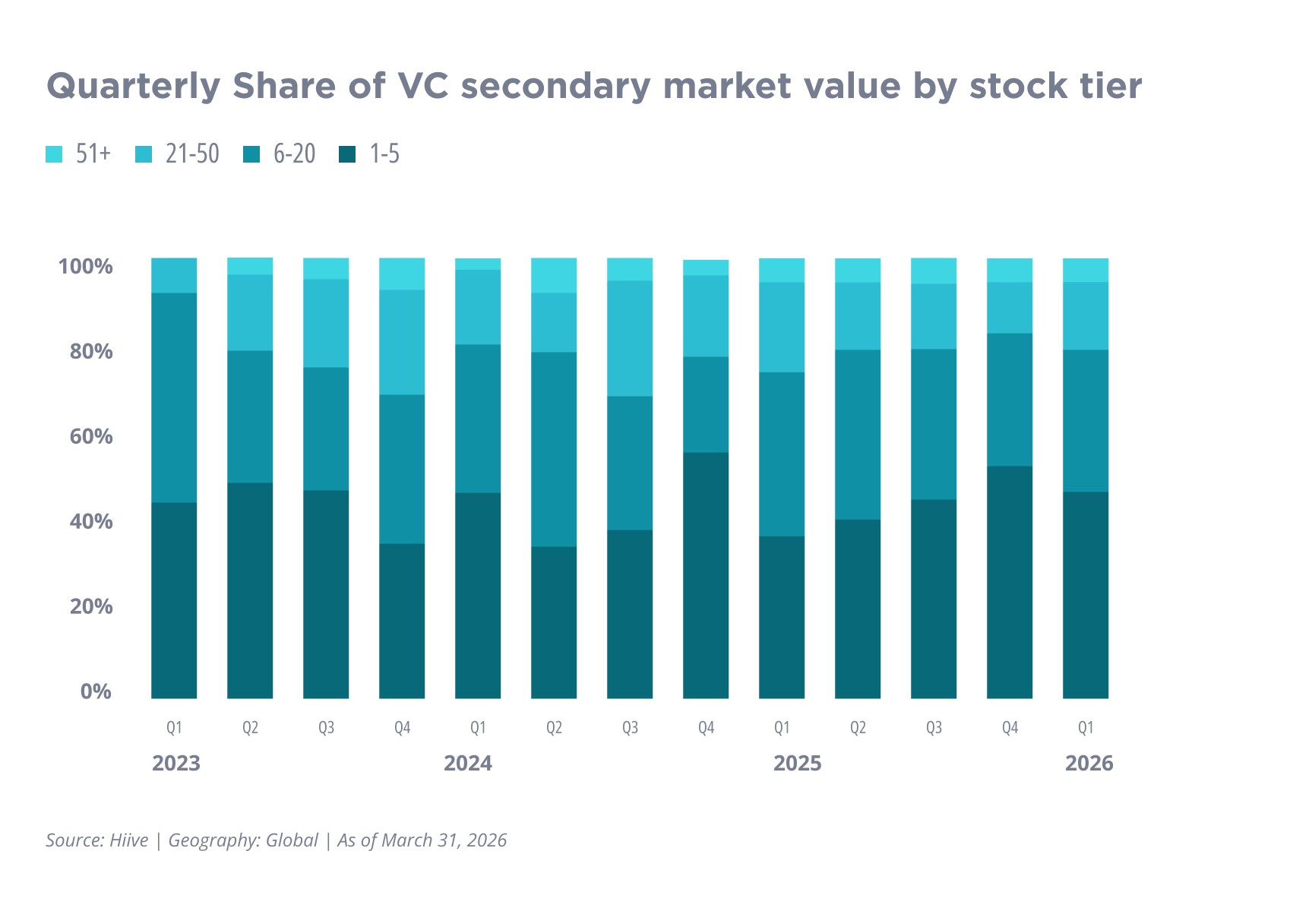
The venture secondary market is becoming concentrated around a narrow set of private companies. Quarter after quarter, the top five names (SpaceX, Anthropic, OpenAI, xAI, and Anduril) account for a disproportionate share of trading volume, while the top twenty consistently dominate overall activity. Investors are gravitating toward companies with scale, liquidity, stronger transparency, and credible paths toward IPO or long-term strategic importance.
This concentration is likely to become even more pronounced as companies such as SpaceX, OpenAI, and Anthropic move closer to public listings. These firms have evolved beyond traditional venture-backed startups and now function as liquidity anchors for the broader private market ecosystem. The Stableton Morningstar PitchBook Unicorn 20 strategy is aligned with this reality, focusing on the category-defining private blue-chip technology companies that consistently attract the majority of secondary demand, institutional attention, and long-term value creation.
THE UNTOLD UNICORN STORY
Neuralink: The neural border of technology and humanity
 CEO & co-founder of Neuralink, Elon Musk. (35)
When Elon Musk and a small team of neuroscientists founded Neuralink in 2016, their goal was as ambitious as it was unprecedented: to create a high-bandwidth bridge between the human brain and computers. What began as a speculative research project has evolved into one of the world’s leading neurotechnology ventures. Neuralink’s brain-computer interface, a coin-sized implant designed to translate neural activity into digital signals, could one day restore movement and communication for people with paralysis.
While full commercialization remains several years away, Neuralink’s steady progress marks a major step toward integrating biotechnology and computing at the neural level. (36)
Fun Fact: The very first day Noland Arbaugh used his Neuralink device, he beat the 2017 world record for speed and precision in BCI cursor control. He's quadriplegic from a diving accident, and now uses the implant ~10 hours a day to study neuroscience, play Mario Kart, and build a speaking business. (37)
Did you know? Neuralink is one of the 20 companies in our Stableton Morningstar PitchBook Unicorn 20 strategy, a systematic, index approach that aims to outperform public benchmarks with low-cost fees, and without a performance fee. Click below for more information.
SOURCES
1 - CNBC, 2 - Financial Times, 3 - NBC, 4 - William Blair, 5 - Breaking Defense, 6 - The Seattle Times, 7 - The Defense Post, 8 - Aljazeera, 9 - Financial Times, 10 - Financial Times, 11 - Bloomberg, 12 - Cursor, 13 - Forbes, 14 - The Information, 15 - Bloomberg, 16 - Bitget, 17 - The Defiant, 18 - Financial Times, 19 - CNBC, 20 - TechCrunch, 21 - Bloomberg, 22 - TechCrunch, 23 - PR Newswire, 24 - The Information, 25 - Reuters, 26 - Bloomberg, 27 - CNBC, 28 - xAI, 29 - Data Center Dynamics, 30 - Bloomberg, 31 - Simply Wall Street, 32 - The Guardian, 33 - Shield AI, 34 - Isar Aerospace, 35 - Digwatch, 36 - Reuters, 37 - Fortune


Every Wednesday, the Navigator delivers a digest of news from our portfolio holdings and key trends shaping private tech investing. Subscribe to receive it directly in your inbox.


