




Databricks Nears $188B Valuation, Stripe Makes $53B Play for PayPal, Revolut Challenges Australia's Big Four
By Stableton on July 22nd, 2026
Big valuations and bigger bets defined this week in private tech. Databricks climbs toward a $188B valuation, Stripe and Advent target PayPal in a $53B acquisition bid, and Revolut breaks into Australia's banking market. Let's dive in…
THIS WEEK’S BREAKING NEWS
Databricks nears $188B valuation in new funding round on AI pivot
Databricks announced a new funding round led by Coatue at a $188B valuation, with the roughly $3B raise expected to close later this summer. The mark follows a $5B raise at $134B in February, $1B at $100B in September 2025, and $10B at $62B in December 2024, an escalating fundraising pace tied to its pivot from big-data software into AI infrastructure. (1)
MARKET UPDATE
Global IPO proceeds triple to $186.8B in H1 2026
Global IPO proceeds tripled to $186.8B in H1 2026 per EY, driven by sustained AI enthusiasm that's now spreading beyond software into data centers, semiconductors, robotics, and advanced manufacturing. The Americas led with $130.3B raised across 84 IPOs, boosted by SpaceX's record listing, as deal count fell to 483 from 546 even as proceeds surged. (2)
STABLETON MORNINGSTAR PITCHBOOK UNICORN 20 STRATEGY

The Stableton Morningstar PitchBook Unicorn 20 strategy is the world’s first passive, systematic, and semi-liquid approach to investing in the Top 20 privately held tech companies before they go public.
This strategy offers a straightforward and cost-effective way to gain exposure to leading private technology companies within a single portfolio. With no performance fees and enhanced liquidity, it offers a unique alternative to traditional private market investments.
STABLETON NEWS
Our Q2 2026 report is here
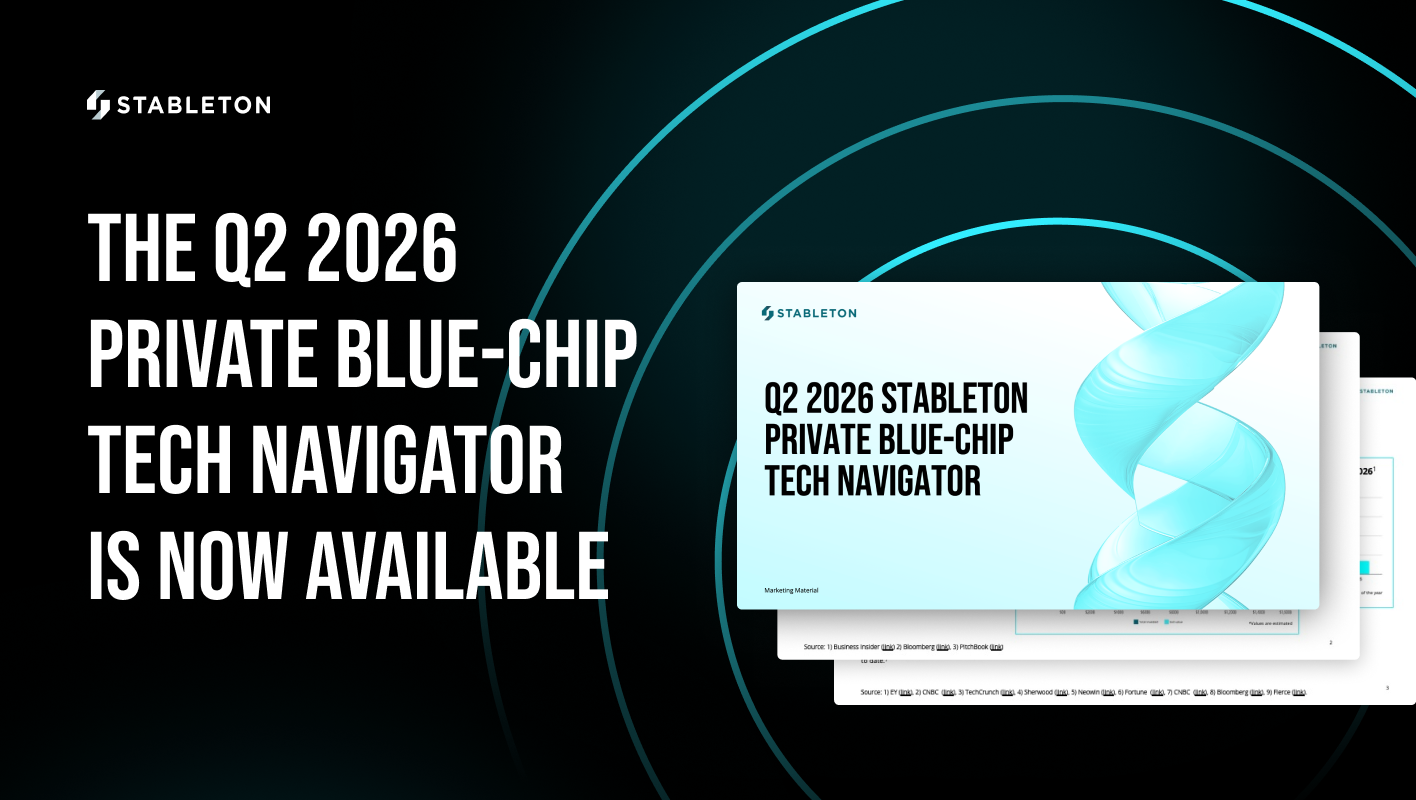
Q2 2026 was one of the biggest quarters we have seen in years.
We saw public market activity picking up significantly, with SpaceX completing the largest IPO in history and Cerebras going public in the same quarter. (3,4) Behind them, both OpenAI and Anthropic have now filed confidentially for their own listings. (5,6) Beyond the IPOs, we also saw a shift in deployment, from Figure AI’s robots entering commercial logistics to the Pentagon expanding classified AI contracts to eight top tech firms. (7,8)
Our latest Private Blue-Chip Tech Navigator breaks down what these new developments mean and where the market is moving next. Inside, we cover the quarter's largest funding rounds, secondary pricing trends, the upcoming IPO calendar, and more.
Download the full report here below.
PORTFOLIO NEWS
Anduril unveils helicopter strike drone Thunder with Archer
Anduril unveiled Thunder, a hybrid-electric helicopter strike drone developed with Archer Aviation and GKN Aerospace, designed to fly alongside attack helicopters like the Apache at three to six per aircraft. Built to cost a small fraction of an Apache, Thunder aims for first flight next year. Anduril is also competing for the UK's Project Nyx, with a winner expected this autumn. (9)
Anduril lands multi-year deal with Pentagon to mass-produce Barracuda-500
Anduril signed a framework agreement with the Department of War to produce thousands of pallet- and lug-launched Barracuda-500 vehicles annually for seven years, with deliveries starting 2027, capped at 8,000 FAMM vehicles per year. The deal builds on a separate 1,000-unit annual surface-launched order, as Anduril scales production at a new $40M+ Southern California facility ahead of its nearly $1B Arsenal-1 plant in Ohio. (10)
Anthropic brings out free Claude access for K-12 teachers
Anthropic launches Claude for Teachers, giving verified US K-12 educators free access through June 30, 2027, connected to Learning Commons' academic standards across all 50 states and nine curricular tools including MagicSchool and Canva Education. The tool includes Claude Code and Cowork for autonomous tasks like scheduled lesson adjustments, with a pilot evaluation planned in Detroit Public Schools. (11)
Anthropic's $1.5B settlement clears final court approval
A federal judge granted final approval of Anthropic's $1.5B copyright settlement, the largest known U.S. copyright case recovery, resolving claims that Anthropic used pirated books to train Claude. Over 91% of eligible authors and publishers have claimed payment, while the court awarded attorneys $101M of the $187.5M requested, following Judge Alsup's 2025 ruling that AI training constitutes fair use. (12)
Epic, Google end feud over third-party Android stores
Epic Games and Google withdrew their bid to settle the antitrust injunction requiring Google to carry third-party Android app stores within Google Play, with compliance beginning July 22. Google will charge stores a $5,000 annual fee for Play catalog access, automatically sharing developer app listings unless they opt out, following Judge Donato's original October 2024 permanent injunction ruling. (13)
Kraken debuts USD-settled crypto options for institutional traders
Kraken launched USD-settled Bitcoin and Ether options on Kraken Pro, targeting institutional traders with European-style contracts across weekly, monthly, quarterly, and semi-annual expiries. The unified system supports collateral in 30+ currencies with automatic portfolio margining, using an RFQ pricing model at launch, ahead of planned expansion into a public order book and broader asset coverage. (14)
Kraken Prop adds Nasdaq 100 as first non-crypto market
Kraken Prop added the Nasdaq 100 as its first market outside crypto, offering 24/7 no-expiry trading with evaluations starting at $20 across Starter, Intermediate, and Advanced tiers funding $5,000-$200,000 accounts. The program applies a 3% max daily loss limit, 2x leverage, and an 80-90% profit split for funded traders, positioning Kraken's regulated exchange status against traditional futures-prop firms. (15)
OpenAI builds AI companion speaker amid Apple lawsuit
OpenAI's first hardware device is reportedly a screenless, mobile smart speaker with "mechanical elements that can move," designed as a personality-driven AI companion syncing with ChatGPT and users' emails. Developed with former Apple engineers, the device arrives as Apple sues OpenAI over alleged trade-secret theft, while rival Hark raised a $700M Series A in May at a $6B valuation for similar AI hardware. (16)
OpenAI unveils GPT-Red for automated AI red-teaming
OpenAI showcased GPT-Red, an automated red-teaming system trained via self-play to attack its own models and expose vulnerabilities before deployment. Built into GPT-5.6 Sol's training, the system cut direct prompt injection failures 6x versus OpenAI's model from four months prior, and found successful attacks in 84% of test scenarios versus 13% for human red-teamers. (17)
Perplexity's new Space sandbox signals a strategy shift toward agentic AI
Perplexity launched Space, a sandboxed security layer for its Computer AI agent, signaling a pivot from AI search toward agentic AI. Analyst Mark Beccue of Omdia noted Perplexity now competes with Google's GKE Agent Sandbox and Microsoft, while Anthropic already dominates agentic AI with a clearly defined enterprise focus that Perplexity has yet to match. (18)
Ramp launches construction-specific spend controls for contractors
Ramp launched Ramp for Construction, adding job-level spend controls, automated retainage tracking, and compliant subcontractor payments to its financial operations platform for a $2.2T U.S. industry. Early results show over 70% of receipts matched within 24 hours, 2.7x more field transactions with accurate cost coding, and 15+ hours saved monthly through automated compliance reviews. (19)
Ramp adds cross-provider AI spend controls for finance
Ramp expanded its AI Token Spend Management product, consolidating usage tracking across OpenAI, Anthropic, Gemini, Cursor, and OpenRouter into one dashboard with weekly briefings and overrun alerts. AngelList Advisors reportedly saved $10,000 monthly after a briefing flagged prompt caching, while Ramp says one in three customers has access to a cheaper model handling the same task, following its $750M Series F at a $44B valuation. (20)
Revolut wins full banking license to challenge Australia's Big Four
Revolut will invest A$400M ($280M) to launch savings and credit products in Australia after securing an unrestricted banking license from APRA, its first Asia-Pacific license and only its second outside the UK and Europe. The $75B-valued fintech, already serving 1.2M Australian customers, aims to challenge the Big Four banks, while also pursuing a New Zealand license and eyeing a $150-200B IPO no sooner than 2028. (21)
Revolut advances UAE expansion with VARA approval
Revolut secured in-principle approval from Dubai's VARA to offer broker-dealer, exchange, and investment services for virtual assets in the UAE, pending final regulatory sign-off. The move follows an earlier Central Bank of the UAE payments approval and builds on Revolut's 75M global customers, including over 16M crypto customers, with services planned through its retail app and standalone exchange, Revolut X. (22)
Ripple joins card giants in backing x402 standard
Ripple joined 40 founding members, including Visa, Mastercard, Stripe, and Google, formalizing governance of the x402 Foundation, the AI agent payment protocol Coinbase built in May 2025. The system settled roughly $24M across 75M payments last month, averaging 32 cents per transaction, positioning Ripple within a machine-to-machine payments standard built for transactions too small for card networks to process profitably. (23)
Starship launch scrubbed as SpaceX shares keep sliding
SpaceX scrubbed its Starship V3 test flight after engines failed to ignite, triggering an automatic abort, with Musk targeting a relaunch early next week after replacing two Raptors. Shares fell over 3% in extended trading to close at $131.11, below its $135 IPO price, marking a five-day losing streak following May's booster mishap during the rocket's prior test flight. (24)
SpaceX eyes Pentagon deal for AI data centers
SpaceX is in talks with the Defense Department to provide billions of dollars in data-center capacity for AI models, following similar deals with Anthropic and Google. The move comes as SpaceX plans to compete more directly with CoreWeave on pricing, while the Pentagon separately seeks $30B for its Artificial Intelligence Arsenal initiative amid concerns over over-reliance on Musk's companies. (25)
Stripe and Advent make $53B play for PayPal acquisition
Stripe and Advent International offered $60.50 per share, a 28% premium, to jointly acquire PayPal for over $53B, backed by roughly $50B in committed bank financing. The deal would combine two payment giants processing $3.7T in annual volume, though PayPal has not yet responded, with William Blair estimating Stripe and Advent could go as high as $70 per share if this is an opening bid. (26)
xAI appeals dismissed trade secret case against OpenAI
xAI appealed to the Ninth Circuit after a federal judge twice dismissed its trade secret lawsuit against OpenAI over alleged data center IP theft, finding no evidence OpenAI knew stolen information was proprietary or used it. OpenAI is now seeking $1,041,859.90 in attorney fees from xAI, which has until late August to respond, with xAI's appeal brief due August 24. (27)
OTHER NEWS
ByteDance unveils full-scene audio model Seed Audio 1.0
ByteDance's Seed Audio 1.0 jointly models voice, sound effects, and ambience within a unified framework, supporting 100ms-precision dialogue timing, zero-shot voice generation, and up to two minutes of audio per pass across 20+ languages. Evaluations showed over 90% availability rate across use cases like film, podcasts, and live commerce, with Naturalness MOS scores above 4.0 in most languages. (28)
Primavera seeks buyers for ByteDance, Ant fund stakes
Primavera Capital is seeking to sell ByteDance and Ant Group shares from an existing fund into a new continuation vehicle; the size of the new fund has not been disclosed. The holdings imply a $600B ByteDance valuation and $120B for Ant. The move follows HSG's earlier ByteDance-anchored continuation fund at a $370B valuation, as private equity firms increasingly use such vehicles to return capital while offering new investors exposure to Chinese tech giants. (29)
Celonis, Valence AI tool cuts deduction disputes to days for finance teams
Celonis partnered with Valence Intelligence to launch the Deductions & Disputes Manager, an AI tool that automates validation of supplier invoice deductions by searching emails, retailer portals, and shipping records. The tool aims to cut resolution times from weeks to days and maximize recovery in an area where deductions can account for 5-15% of gross sales in the Consumer Packaged Goods industry. (30)
Crusoe's Project Flash surfaces in Franklin County, Virginia
Crusoe is in discussions with Franklin County, Virginia officials since November about "Project Flash," a potential 50-100MW data center on 150 acres within Summit View Business Park, revealed via FOIA requests. The project joins Crusoe's broader pipeline, which now exceeds 40GW total, including a 1.8GW Wyoming campus and a newly announced gigawatt-scale Childress, Texas campus, with 4.9GW already contracted. (31)
Crusoe, Lancium build 1GW AI campus in Childress, Texas
Crusoe and Lancium announced a 1.0GW AI data center campus in Childress, Texas, spanning 270 Lancium-owned acres with water-efficient closed-loop cooling and construction starting Q3 2026. The project extends their Abilene partnership model, where the campus scaled to 1.2GW with a second 900MW facility now underway, and is expected to create thousands of construction jobs and 100+ permanent positions. (32)
Valeo enters drone sector with Harmattan AI deal
Valeo will develop and manufacture electric drone motors in France for Harmattan AI, avoiding heavy rare earths to secure the supply chain, with production starting in early 2027. The motors will serve both civil and defense applications, marking Valeo's first drone-sector contract and supporting what CEO Christophe Périllat called national sovereignty. (33)
CI&T becomes Mistral's preferred AI partner in LATAM for agentic enterprise deployment
CI&T and Mistral announced a multi-year partnership to deliver joint AI offerings built on Mistral's open-weight models, with CI&T serving as the preferred LATAM partner for localized deployment. The collaboration spans an end-to-end private AI stack aimed at helping enterprises modernize applications and advance toward agentic operations, combining CI&T's transformation expertise with Mistral's frontier AI capabilities. (34)
Vikar integrates Plaid to speed up digital account opening
Vikar Technologies integrated Plaid's API suite, including Auth and Signal, to automate identity verification and instant account funding within its client lifecycle management platform. The partnership cuts account opening and funding time from days to minutes, replacing manual document uploads and micro-deposits with real-time data validation, aimed at helping mid-tier banks and credit unions compete with digital-native neobanks. (35)
Powerlaw discloses new stakes in Prometheus, Shield AI
Powerlaw Corp. disclosed Prometheus and Shield AI as new holdings in its June 30, 2026 Schedule of Investments filed with the SEC. Prometheus, Jeff Bezos's physical AI startup, has raised $18.2B in eight months at a $41B valuation, while Shield AI's Hivemind autonomy software entered a funded U.S. Air Force production program, guiding to over 80% revenue growth in 2026 after $300M in 2025. (36)
Cloudera, Vast Data build unified AI factory for GPU starvation issues
Cloudera and Vast Data partnered on a "unified AI factory," combining Cloudera's data lakehouse architecture with Vast Data's AI Operating System to eliminate "GPU starvation," where idle GPUs wait on data pipelines that weren't built for continuous AI workloads. The platform integrates Nvidia's cuVS and NIM microservices, running on-premises or in the cloud, and is available now through both companies' sales teams. (37)
CHART OF THE WEEK
Secondaries are becoming a strategic allocation
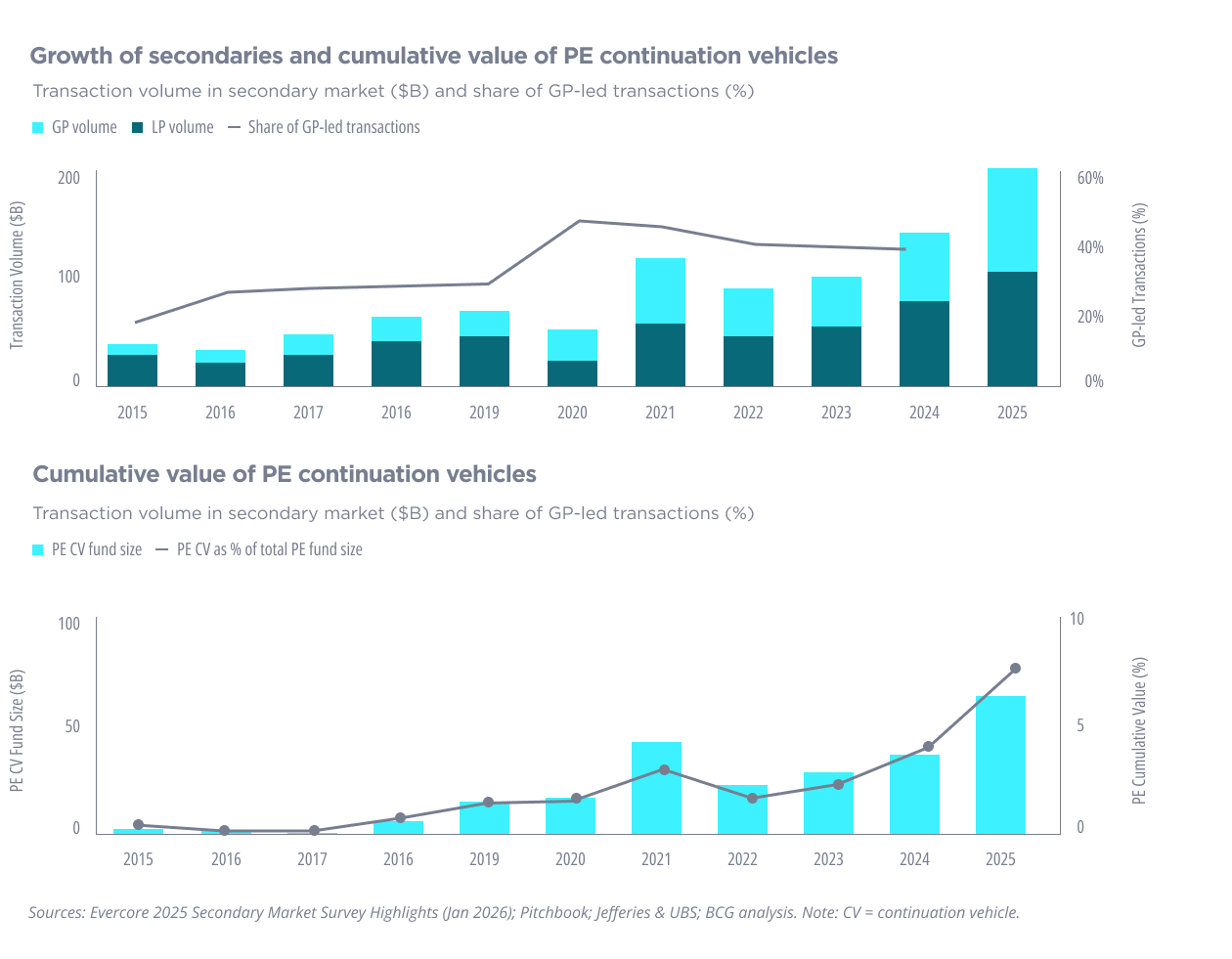
Secondaries have grown from a niche corner of private markets into one of its fastest-growing segments, and the rise of GP-led deals tells you why.
Continuation vehicles are driving this. Their value has grown sharply, letting GPs keep their top assets while still giving investors a way out if they want one. Institutional investors like this trade-off: less blind-pool risk, shorter hold periods, and assets with a track record already proven.
The result is a private market that looks different than it did a decade ago. Secondaries now offer discounted entry points, earlier cash flow, and exposure to companies that have already scaled, all while the space grows more institutional and liquidity-focused.
That shift matters for where the money goes next. As allocation and conviction rise together, more long-term capital is flowing directly into infrastructure, technology, and other private sectors, expanding the pool of capital available to private companies.
The Stableton Morningstar PitchBook Unicorn 20 strategy is built for this shift, giving investors exposure to the private blue-chip tech leaders where secondary liquidity and institutional demand run deepest.
THE UNTOLD UNICORN STORY
Databricks: The long road from open source to $188 billion
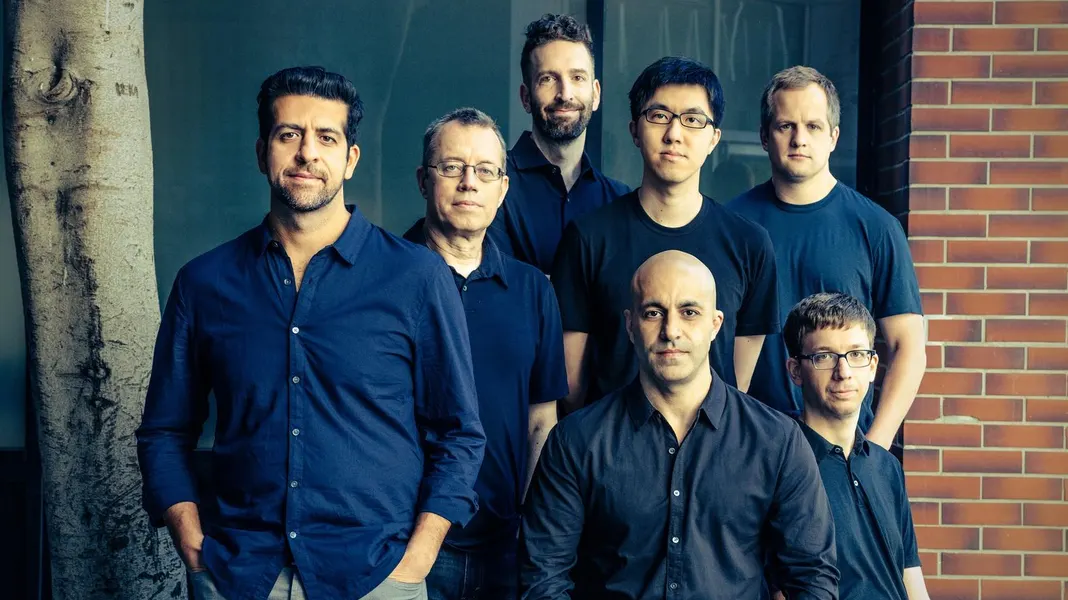 Databricks' 7 cofounders. Standing, from left: Arsalan Tavakoli, Ion Stoica, Andy Konwinski, Reynold Xin, Patrick Wendell. Sitting, from left: Ali Ghodsi, Matei Zaharia. (38)
Databricks began with seven UC Berkeley researchers and a hard lesson about turning research into revenue. In 2009, PhD student Matei Zaharia began developing Apache Spark, an open-source engine for processing massive datasets. Spark itself spread rapidly through the developer community, but the founders saw that enterprises needed a managed platform to deploy it without wrestling with the infrastructure themselves. So in 2013, the seven of them founded Databricks. (39)
Venture capitalist Ben Horowitz believed a hundred-billion-dollar company could be built on the technology, and Andreessen Horowitz led a $13.9 million Series A in September 2013. (40) But commercial traction was slow; Databricks had only about $1 million in revenue going into a later funding round. In January 2016, Ali Ghodsi took over as CEO and pivoted hard to enterprise sales. (41) A decade later, Databricks is one of the most valuable private companies in the world.
Fun Fact: In 2014, Databricks set a world record by sorting 100 terabytes of data in 23 minutes using 206 machines. The previous record, held by Yahoo, took 72 minutes on 2,100 machines.
Did you know? Databricks is one of the 20 companies in our Stableton Morningstar PitchBook Unicorn 20 strategy, a systematic, index approach that aims to outperform public benchmarks with low-cost fees, and without a performance fee. Click below for more information.
SOURCES
1 - TechCrunch, 2 - CFO Tech Asia, 3 - NPR, 4 - CNBC, 5 - The Guardian, 6 - Bloomberg, 7 - Figure AI, 8 - The Guardian, 9 - Financial Times, 10 - Anduril, 11 - Anthropic, 12 - Reuters, 13 - The Verge, 14 - FF News, 15 - Kraken Blog, 16 - TechCrunch, 17 - OpenAI, 18 - AI Business, 19 - PR Newswire, 20 - SiliconANGLE, 21 - Financial Times, 22 - Finance Magnates, 23 - CoinDesk, 24 - CNBC, 25 - The Wall Street Journal, 26 - Reuters, 27 - Data Center Dynamics, 28 - ByteDance, 29 - Bloomberg, 30 - CFO Tech Australia, 31 - Data Center Dynamics, 32 - Crusoe, 33 - Reuters, 34 - Business Wire, 35 - FF News, 36 - Business Wire, 37 - SiliconANGLE, 38 - Forbes, 39 - Contrary Research, 40 - Reuters, 41 - Growfers



Every Wednesday, the Navigator delivers a digest of news from our portfolio holdings and key trends shaping private tech investing. Subscribe to receive it directly in your inbox.


