




OpenAI Partners with Accenture, Revolut Expands Nasdaq Partnership, Stripe Powers Klarna Stablecoin
By Stableton on December 3rd, 2025
Here’s what stood out this week across our portfolio holdings: an AI infrastructure leader is preparing a multi-billion-dollar raise that could reshape the competitive landscape, a major enterprise partnership is set to accelerate real-world deployment of agentic AI, and a fast-growing frontier-model developer is nearing a landmark funding round to power its next stage of scale. Let’s dive in…
THIS WEEK’S BREAKING NEWS
OpenAI expands enterprise reach with Accenture partnership
Accenture and OpenAI have formed a deep enterprise partnership that equips tens of thousands of Accenture professionals with ChatGPT Enterprise and OpenAI Certifications—the largest deployment to date. The firms will jointly develop industry-specific AI solutions using OpenAI’s agentic capabilities, with Accenture integrating these tools into consulting, operations and delivery. A flagship client program will accelerate adoption across functions such as finance, supply chain, HR and customer operations. (1)
STABLETON MORNINGSTAR PITCHBOOK UNICORN 20 STRATEGY

The Stableton Morningstar PitchBook Unicorn 20 strategy is the world’s first passive, systematic, and semi-liquid approach to investing in the Top 20 privately held tech companies before they go public.
This strategy offers a straightforward and cost-effective way to gain exposure to leading private technology companies within a single portfolio. With no performance fees and enhanced liquidity, it offers a unique alternative to traditional private market investments.
PORTFOLIO NEWS
Anduril partners with UAE amid rising drone threats
EDGE Group, the UAE’s largest defense manufacturer with $5B in annual revenue, has made air-defense development its top priority through SkyKnight, a short-range system designed to counter drone swarms and slated for 2026 deployment. The company is accelerating strategic autonomy through joint ventures and global partnerships, including a new drone venture with Anduril and a $7B defense pact with Indonesia. (2)
Anthropic models estimate AI could double productivity growth
Anthropic’s new study estimates that current-generation AI could lift U.S. annual labor productivity growth by 1.8%, effectively doubling the post-2019 average. Using 100,000 Claude interactions, researchers quantified task-level time savings and translated them into economy-wide impacts, implying a 1.1% yearly total factor productivity boost under full diffusion in ten years. However, the model depends on optimistic assumptions about time reallocation, accuracy checks, and fixed AI capabilities. (3)
Kraken launches Bitcoin rewards card ahead of IPO
Kraken has launched a Mastercard-powered Bitcoin rewards debit card for UK and EU users, offering 1% cashback in Bitcoin or local fiat and enabling global payments across 400+ supported assets via its Krak app. The rollout comes as Kraken confidentially filed for an IPO and raised $800M at a $20B valuation. The firm aims to expand the card to the U.S. and introduce additional rewards and credit features. (4)
Neuralink shows meaningful progress in human BCI trials
Neuralink reported another successful real-world use case of its brain–computer interface, with a paralyzed trial participant controlling first-person shooter gameplay purely through thought-driven cursor movement. The company has now implanted its device in 12 human subjects, with multiple participants demonstrating precise, repeatable control across applications. The results highlight meaningful functional gains and growing validation of Neuralink’s BCI technology. (5)
OpenAI growth strategy leans on $100B third-party balance sheets
OpenAI’s expansion is increasingly financed through its partners’ balance sheets, with SoftBank, Oracle, CoreWeave, Blue Owl, Crusoe and others collectively on track to accumulate nearly $100B in debt tied to OpenAI-related data-centre and compute buildouts. These obligations support more than $1.4T in long-term compute procurement commitments, far exceeding OpenAI’s expected $20B annualised revenue, while the company itself retains minimal leverage and has yet to draw on its $4B credit facility. (6)
OpenAI expands AI deployment via Thrive Holdings stake
OpenAI has taken an ownership stake in Thrive Holdings, the operating platform created by major investor Thrive Capital, to accelerate AI adoption across real-economy sectors such as accounting and IT services. OpenAI will embed engineering, research and product teams directly into Thrive’s portfolio companies, with the stake structured to grow as those businesses scale. The move extends OpenAI’s broader strategy of circular partnerships with key infrastructure and operating partners. (7)
OpenAI and Perplexity redefine online shopping via AI
OpenAI and Perplexity are rolling out integrated AI-shopping assistants that let users transition seamlessly from product discovery to checkout. Users can prompt AI chatbots for product recommendations and then complete purchases directly in chat. The move taps into growing demand for AI-enabled commerce and poses a significant competitive challenge to niche-focused retail-AI startups. (8)
PayPal powers Perplexity’s new agentic commerce engine
PayPal and Perplexity launched Instant Buy, enabling U.S. users to move from product discovery to checkout directly inside Perplexity’s AI chat. PayPal provides identity verification, fraud screening, merchant protection, and real-time catalog integration, positioning itself as the commerce engine for Perplexity’s agentic shopping experience. Merchants gain immediate access without technical lift, while users receive a limited-time 50% cashback incentive up to $50. (9)
Revolut navigates regulatory concerns over CEO residency disclosure
UK regulators only learned through media reports that Revolut CEO Nik Storonsky was listed as a UAE resident in his family office filings, prompting concerns as the fintech seeks a full UK banking licence. Revolut maintains Storonsky continues to manage the company from the UK, despite dividing his time across multiple regions. The episode adds scrutiny as regulators assess governance, risk controls and readiness for a full licence at a $75B valuation. (10)
Revolut consolidates regulatory workflows with Nasdaq partnership
Nasdaq has expanded its regulatory technology partnership with Revolut, integrating Nasdaq AxiomSL across the fintech’s UK and European operations to consolidate regulatory reporting into a single cloud-managed platform. The deployment strengthens Revolut’s global expansion by centralizing data, automating compliance updates across jurisdictions, and reducing operational fragmentation. Nasdaq AxiomSL provides scalable infrastructure, enabling Revolut to meet evolving regulatory expectations without slowing product velocity. (11)
Broader Singapore license, stronger foundation for Ripple Payments
Ripple secured an expanded Major Payment Institution license from Singapore’s MAS, allowing it to scale regulated blockchain-based payment services across the region. The approval broadens the firm’s ability to support institutions using Ripple Payments and enhances the regulatory foundation for RLUSD and XRP adoption. With Singapore’s structured oversight and regional influence, the decision strengthens Ripple’s position in cross-border infrastructure as financial institutions increasingly test digital settlement rails. (12)
Taiwan Launches Formosat-8 Satellite via SpaceX
SpaceX has successfully deployed Taiwan’s first Formosat-8 satellite, the Chi Po-lin Satellite, marking a major milestone in the country’s Earth-observation program. The spacecraft delivers 1-meter imaging resolution, enhanced to 0.7 meters, and forms part of an eight-satellite constellation designed for disaster response and security monitoring. When fully operational by 2031, the system will offer up to three daily passes and expanded regional data access. (13)
Stripe powers Klarna’s stablecoin push into global payments
Klarna introduced KlarnaUSD, a USD-backed stablecoin issued through Stripe subsidiary Bridge and launched on the Tempo blockchain to cut cross-border payment costs. The token is live on Tempo’s testnet and targeted for mainnet in 2026. Klarna cites crypto’s improved speed, cost efficiency, and security as drivers, aligning its payments scale with Stripe–Paradigm infrastructure built for high-throughput settlement. (14)
xAI nears $15B raise at $230B valuation
xAI is expected to close a $15B funding round in December at a $230B pre-money valuation, confirming earlier reports despite Musk’s public denial. The raise follows rapid valuation expansion across foundational-model developers, including OpenAI’s recent $500B secondary sale and Anthropic’s $13B round. Capital will largely finance GPU capacity for training and scaling xAI’s Grok model. (15)
OTHER NEWS
ByteDance reopens Moonton sale talks with Savvy Games
ByteDance is reviving plans to sell Shanghai Moonton Technology, holding talks with Saudi Arabia’s Savvy Games Group, backed by the Public Investment Fund. ByteDance bought Moonton in 2021 at a $4B valuation but has been retreating from gaming amid job cuts and the shutdown of Nuverse. A sale would align with PIF’s push to build a global gaming hub and comes amid a 34% rebound in China-related M&A activity. (16)
HSBC taps Mistral to accelerate enterprise AI deployment
HSBC has entered a multi-year strategic partnership with Mistral AI to integrate frontier generative-AI models across global operations. The bank will embed Mistral’s commercial models into internal productivity platforms, enhancing financial analysis, multilingual reasoning, document processing, and workflow automation. Both firms will co-develop enterprise gen-AI solutions, with future focus areas including onboarding, lending, fraud prevention, and customer-facing services under strict governance and responsible-AI standards. (17)
Groq accelerates APAC expansion with Equinix-backed AI hub
Groq has expanded into Asia-Pacific through a partnership with Equinix, deploying a 4.5MW AI-inference facility in Sydney designed to deliver up to five-times-faster and more cost-efficient compute than traditional GPUs or hyperscaler clouds. The site anchors Groq’s regional expansion, enabling low-latency access across Australia and Southeast Asia. Built on GroqCloud and Equinix Fabric, the deployment targets enterprise demand for faster, high-performance AI inference at scale. (18)
CHART OF THE WEEK
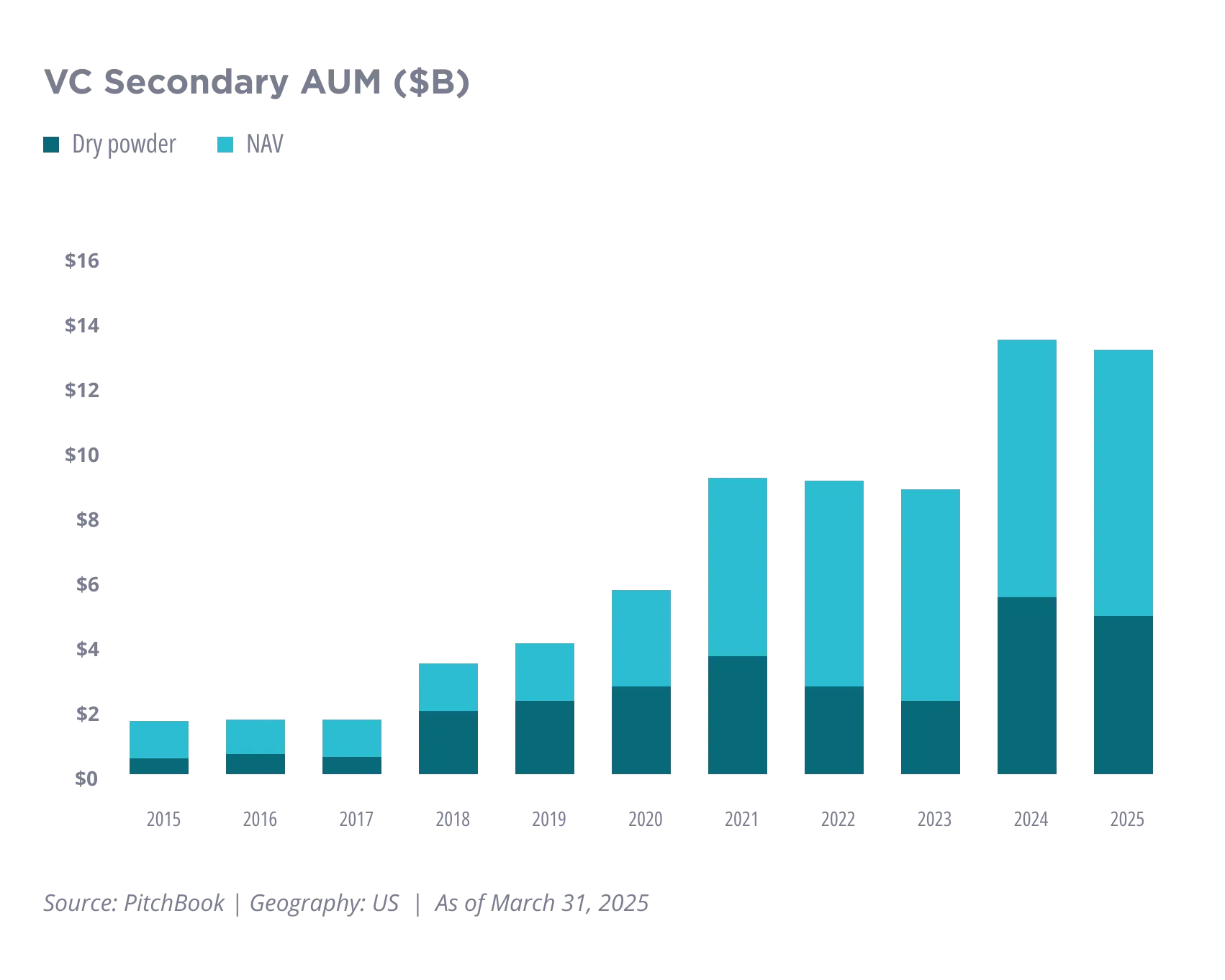
Rising secondary AUM marks a decisive shift in how private markets are being accessed. Institutions no longer view secondaries as an emergency liquidity valve. They increasingly see them as a core tool to manage exposure to late-stage private technology. As capital accelerates into both LP-led and direct secondaries, the market becomes deeper, pricing becomes more transparent, and allocations become less dependent on traditional fund cycles. This is the real story behind the chart: secondaries are turning into a scalable and repeatable way to participate in private market value creation that behaves much closer to the structure and predictability of public markets.
For allocators, this evolution shows why late-stage secondaries now operate as a durable exposure rather than a timing decision. Clearer pricing and tighter dispersion improve the reliability of accessing the strongest private tech companies. The Stableton Morningstar PitchBook Unicorn 20 is built for this environment, providing systematic and index-like access to the segment as it reaches institutional maturity.
THE UNTOLD UNICORN STORY
Anduril Defense technology reimagined
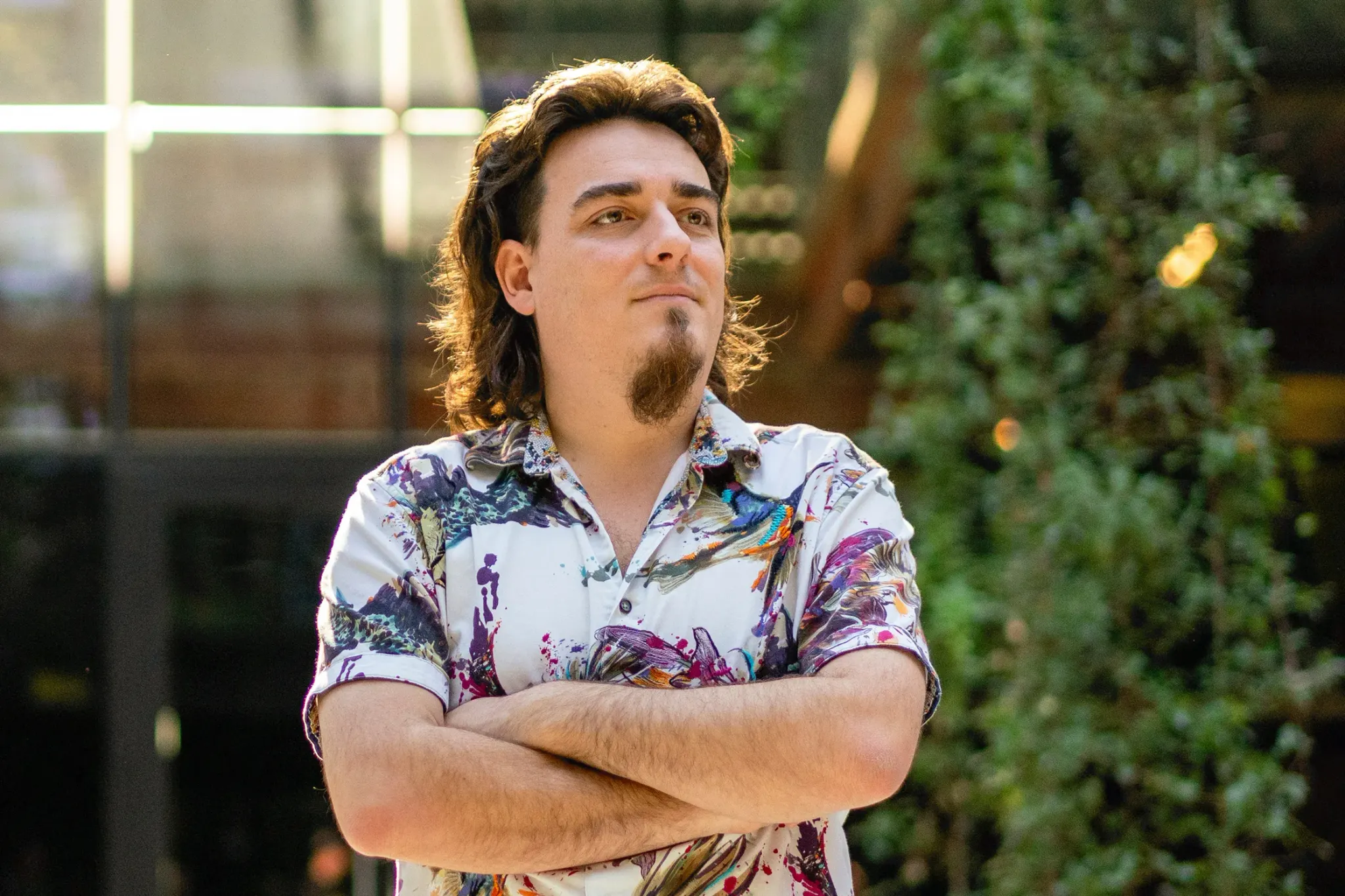
Co-Founder of Anduril, Palmer Luckey, at Anduril HQ in California. (19)
Founded in 2017, Anduril applies software-first engineering to defense challenges, accelerating the deployment of autonomous systems for force protection and surveillance. Its core platform, Lattice, connects sensors and autonomous vehicles so a single operator can manage air, land, and maritime systems at scale. By pairing low-cost, modular hardware with an adaptive software stack, Anduril replaces slow, bespoke defense programs with systems that can evolve through continuous iteration.
Its flagship products include Roadrunner and Roadrunner-M, reusable autonomous aircraft for counter-UAS and short-range air defense, and Fury, an uncrewed combat jet designed to operate alongside manned fighters. Together, they reflect a “Moneyball” military model focused on affordability, scale, and speed of deployment, a strategy driving new U.S. Department of Defense contracts as Anduril transitions from prototyping to full production. (20)
Fun Fact: Founder Palmer Luckey previously founded Oculus, a virtual reality headset, which popularized the VR industry before he turned to defense technology. Anduril now combines that product engineering mindset with defense procurement to scale autonomous systems.
Did you know? Anduril is one of the 20 companies in our Stableton Morningstar PitchBook Unicorn 20 strategy, a systematic, index-like approach that aims to outperform public benchmarks with low-cost fees, and without a performance fee. Click below for more information.
SOURCES
1 - OpenAI, 2 - Bloomberg, 3 - Time, 4 - Decrypt, 5 - Futurism, 6 - Financial Times, 7 - CNBC, 8 - TechCrunch, 9 - PYMNTS, 10 - Financial Times, 11 - Fintech Magazine, 12 - Fintech Weekly, 13 - Parameter, 14 - The Block, 15 - CNBC, 16 - Bloomberg, 17 - HSBC, 18 - NewsBytesPH, 19 - WIRED, 20 - Aspen Security


Every Wednesday, the Navigator delivers a digest of news from our portfolio holdings and key trends shaping private tech investing. Subscribe to receive it directly in your inbox.


