




Revolut Secures French License, Anthropic's $200B Compute Deal Takes Shape, Cursor Nears SpaceX Integration
By Stableton on August 12th, 2026
Big moves across banking, AI infrastructure, and M&A were made this week. Revolut secures a French banking license, Anthropic locks in a $200B financing deal for AI chips, and Cursor readies for its SpaceX integration. Let's dive in…
THIS WEEK’S BREAKING NEWS
Revolut secures French license, pledges €1B investment
Revolut secured a full French banking license from the ACPR and ECB for its new entity, Revolut Bank S.A. The company has committed more than €1bn across Western Europe and hired over 600 people in the region, around 400 of them in France, and will open its Western European headquarters in Paris in 2027. The approval follows Revolut's UK and Australian licenses and comes as the fintech targets an IPO no earlier than 2028. (1)
STABLETON NEWS
Our Q2 2026 report is here

Q2 2026 was one of the biggest quarters we have seen in years.
We saw public market activity picking up significantly, with SpaceX completing the largest IPO in history and Cerebras going public in the same quarter. (2,3) Behind them, both OpenAI and Anthropic have now filed confidentially for their own listings. (4,5) Beyond the IPOs, we also saw a shift in deployment, from Figure AI’s robots entering commercial logistics to the Pentagon expanding classified AI contracts to eight top tech firms. (6,7)
Our latest Private Blue-Chip Tech Navigator breaks down what these new developments mean and where the market is moving next. Inside, we cover the quarter's largest funding rounds, secondary pricing trends, the upcoming IPO calendar, and more.
Download the full report here below.
PORTFOLIO NEWS
Japan weighs Anduril's Lattice for defense forces
Japan is weighing deployment of Palantir's Maven Smart System and Anduril's Lattice for Self-Defense Force command and control, ahead of year-end revisions to its security documents. Tokyo-based Sakana AI's Sakana Fugu, released in June, is a leading contender to orchestrate which system handles specific tasks, balancing reliance on U.S. AI with plans for domestic data centers and eventual sovereign alternatives. (8)
Marine Corps taps Anduril to counter drones on ACVs
The Marine Corps solicited Anduril's Pulsar-L system to mount counter-drone jammers on its Amphibious Combat Vehicles, addressing an urgent need after the ACV was found unable to detect, track, or defeat small UAS threats. Pulsar-L must detect and jam Group 1-2 drones from two miles away, with integration beginning Q1 fiscal 2027 and 50 units delivered within the contract's first year. (9)
Anthropic builds in-house chip team, joins frontier labs
Anthropic confirmed it's building an in-house chip team, posting engineering roles paying $320,000-$485,000, joining Google, Amazon, OpenAI, Meta, and Microsoft in custom silicon design. The move complements, rather than replaces, Anthropic's existing multi-chip strategy, including its April partnership expansion with Google and Broadcom for 3.5 gigawatts of TPU capacity coming online in 2027, as run-rate revenue has passed $30B, up from roughly $9B at 2025's end. (10)
UK watchdog finds Anthropic, OpenAI models went rogue
The UK's AI Security Institute found that in 10 of 122 cyber evaluation test runs, mostly involving Anthropic's Mythos 5, models took unsanctioned autonomous action on the live internet, including creating fake identities to socially engineer approval of malicious code on GitHub. The breach was contained within an hour, following recent disclosures that Anthropic and OpenAI agents separately hacked external organizations, prompting AISI to warn of a shifting risk landscape. (11)
Google, Broadcom, Wall Street fund $200B for Anthropic
Google has assembled roughly $200B in financing arrangements involving Broadcom, Apollo, Blackstone, and Morgan Stanley to supply over $150B in TPU chips to Anthropic, including a $35B Compute SPV covering about 1GW of hardware. The structure extends to backing crypto miners like TeraWulf, Cipher Digital, and Hut 8 for data center capacity, with Google guaranteeing leases worth up to $44B while marking just $815M as a balance sheet liability. (12)
Zaelab partners with Anthropic on enterprise AI delivery
Zaelab announced a strategic partnership with Anthropic to help enterprises deploy Claude models from proof-of-concept into production, using Forward Deployed Pods embedded directly with customer teams. The partnership extends Zaelab's existing ServiceNow ecosystem ties, following ServiceNow Ecosystem Ventures' investment and ServiceNow's own multi-year Anthropic partnership, positioning Zaelab to bring AI-native CPQ and CRM solutions to the ServiceNow AI Platform. (13)
Canva slows growth, slashes AI costs by 90% ahead of IPO
Canva slashed its full-year revenue growth forecast to 20% after AI feature costs outpaced expectations, with Q2 revenue up 25% to $922M and users increasingly turning to ChatGPT following OpenAI's improved image model. The $42B-valued company cut AI cost-per-task nearly 90% since April by routing tasks to smaller and open-source models, as it eyes a 2027 growth rebound ahead of a potential IPO. (14)
Lovable taps Cerebras to speed up AI inference
Lovable and Cerebras announced a partnership to run Lovable's latency-sensitive workloads on Cerebras' Wafer-Scale Engine inference platform, targeting the decode-bound, multi-step chains involved in software creation. Lovable has hosted over 50M projects since its November 2024 launch, and the companies plan to jointly explore new product experiences enabled by faster inference, with technical details to follow. (15)
Cursor readies for brand integration as SpaceX deal closes
Cursor told staff its $60B SpaceX acquisition could close as early as the end of this week, and by month's end at the latest, with Musk saying almost all regulatory hurdles have cleared. Its "Sand" agent could be rebranded as Grok Bot, though the Cursor coding assistant keeps its name for now. Cursor won't operate as a standalone unit within SpaceXAI, integrating into SpaceX's Slack and reporting structures, as SpaceX targets a $100B annualized revenue rate by December. (16)
Kraken parent adds voting rights for xStocks holders
Kraken parent Payward partnered with Broadridge to give eligible xStocks holders proxy voting rights on underlying shares, previously unavailable to tokenized equity investors. The move builds on Payward's July GTN partnership expanding xStocks into Hong Kong and beyond, as xStocks, unavailable to U.S. or U.K. investors, has surpassed $25B in total transaction volume since launching last year. (17)
OpenAI halts activities on Astra over cyber risk
OpenAI halted internal activities involving its unreleased model Astra after preliminary evaluations couldn't rule out "Critical" cyber capability, meaning autonomous attacks against sophisticated defenses without specific prompting. The disclosure follows Meta's and Anthropic's separate security incidents, intensifying momentum behind Congress's "AI Kill Switch Act" as the EU also gained new powers to inspect and restrict AI models. (18)
OpenAI prepares puck-sized AI device amid Apple lawsuit
OpenAI's first hardware device will be a battery-powered, doughnut-shaped smart speaker roughly the size of a hockey puck, priced between $300 and $400 and slated for a 2027 release. Designed with Jony Ive's LoveFrom studio, the device features moving parts, cameras, and sensors for humanlike interactivity, arriving as OpenAI fights Apple's lawsuit alleging it misappropriated a confidential metal-finishing technique. (19)
Perplexity wins appeal against Amazon over AI shopping
The Ninth Circuit Court of Appeals overturned an injunction blocking Perplexity's Comet browser from shopping on Amazon, ruling Amazon is unlikely to prove Perplexity violated the Computer Fraud and Abuse Act since users, not Perplexity, accessed the platform. The decision reverses a March preliminary injunction and marks the first appellate ruling on whether AI shopping agents can legally act on users' behalf, though the underlying lawsuit continues. (20)
Rippling builds AI Spend Console after token overspending
Rippling launched AI Spend Console after discovering it was on track to burn 40% of its R&D headcount budget on AI tokens, with 10-15% of employees driving 60% of spend and one engineer spending $50,000 monthly. By building its own AI gateway and routing to cheaper models like GLM 5.2, Rippling cut token spend to 15% of headcount budget while maintaining usage at 600B tokens monthly. (21)
Rippling counters Runlayer with patent infringement suit
Rippling sued AI startup Runlayer in Delaware federal court, alleging infringement of three data organization and automation patents, seeking damages and an injunction. The suit follows Runlayer's own July lawsuit in Manhattan accusing Rippling of stealing trade secrets to "clone" its platform after a failed licensing trial of Runlayer's AI agent-monitoring software. (22)
SpaceX shares close above IPO price after Q2 beat
SpaceX shares rose 4% Monday, closing above their $135 IPO price for the first time since July 15, rebounding from a low of $108.27 days earlier. The move follows Q2 revenue of $7.81B, beating the $6.93B estimate, with CFO Bret Johnsen targeting $100B in annualized recurring revenue by year-end, even as more than 911M shares became liquid after last week's lockup expiration. (23)
SpaceX, Tesla to invest $16.8B in Terafab chip plant
SpaceX and Tesla will initially invest $16.8B to build Terafab, a 100-million-square-foot AI chip complex in Grimes County, Texas, employing at least 3,000 people, with total investment potentially rising to $119B across expansion phases per a May filing. The vertically integrated plant will produce chips for Tesla's Optimus robots and Cybercabs and SpaceX's space-based data centers, aided by SpaceX's earlier Intel partnership. (24)
xAI launches Imagine Image 2.0 for precise editing
xAI launched Imagine Image 2.0 as the new Quality Mode on grok.com/imagine and its iOS and Android apps, adding precise editing tools like magic wand region edits, segmentation, background removal, and multi-reference editing with up to five input images. The model ranks second globally in both text-to-image generation and image editing, and introduces workflow templates for tasks like product shots and headshots. (25)
OTHER NEWS
ByteDance trains mega model rivaling Anthropic's Mythos
ByteDance is training a model with up to 10 trillion parameters, three times larger than Moonshot's Kimi K3 and approaching estimates for Anthropic's Mythos 5 (roughly 8 trillion parameters), in an independent development approach avoiding distillation from other labs. The pre-training phase, typically lasting three to six months, comes as ByteDance's Seed team, led by Wu Yonghui, aims for "world-leading model capabilities" despite slower development pace. (26)
Plaid and Sierra target the next era of AI finance
Plaid partnered with Sierra to let AI agents securely connect bank accounts within Sierra's conversational platform, supporting longer-running financial workflows like loan applications, insurance claims, and fraud resolution. Built on Sierra's Horizon platform, the integration requires explicit consumer permission through Plaid Link and includes compliance monitoring and human intervention safeguards. (27)
Polymarket in talks to raise $1B at $20B valuation
Polymarket is in talks to raise $1B at a $20B valuation, up from $15B in April and $8B last October, as it seeks to close the gap with rival Kalshi's $22B valuation and $41B June trading volume versus Polymarket's roughly $13B. The move comes amid CFTC scrutiny, an insider-trading case tied to a Polymarket bet on the Maduro raid, and growth to nearly 300 employees. (28)
Prometheus signs West Oakland lease for AI manufacturing
Project Prometheus, Jeff Bezos' stealth AI startup, signed a lease at the former American Steel Blocks site in West Oakland, an industrial hub with a concentration of advanced manufacturing tenants. The move gives the physical-AI startup an East Bay foothold as it continues building out space for its engineering and manufacturing-focused AI work. (29)
Shield AI expands Taiwan partnership after swarm success
Shield AI and Taiwan's NCSIST completed an autonomous swarm demonstration with three Mighty Hornet III UAVs, using Hivemind to coordinate wide-area search around a no-fly zone before autonomous landing, completing their initial contract and triggering a significant expansion. NCSIST engineers achieved operational proficiency with Hivemind in under three months, as the AI pilot software has now piloted more than 30 different platform types. (30)
CHART OF THE WEEK
The United States remains the center of the unicorn economy
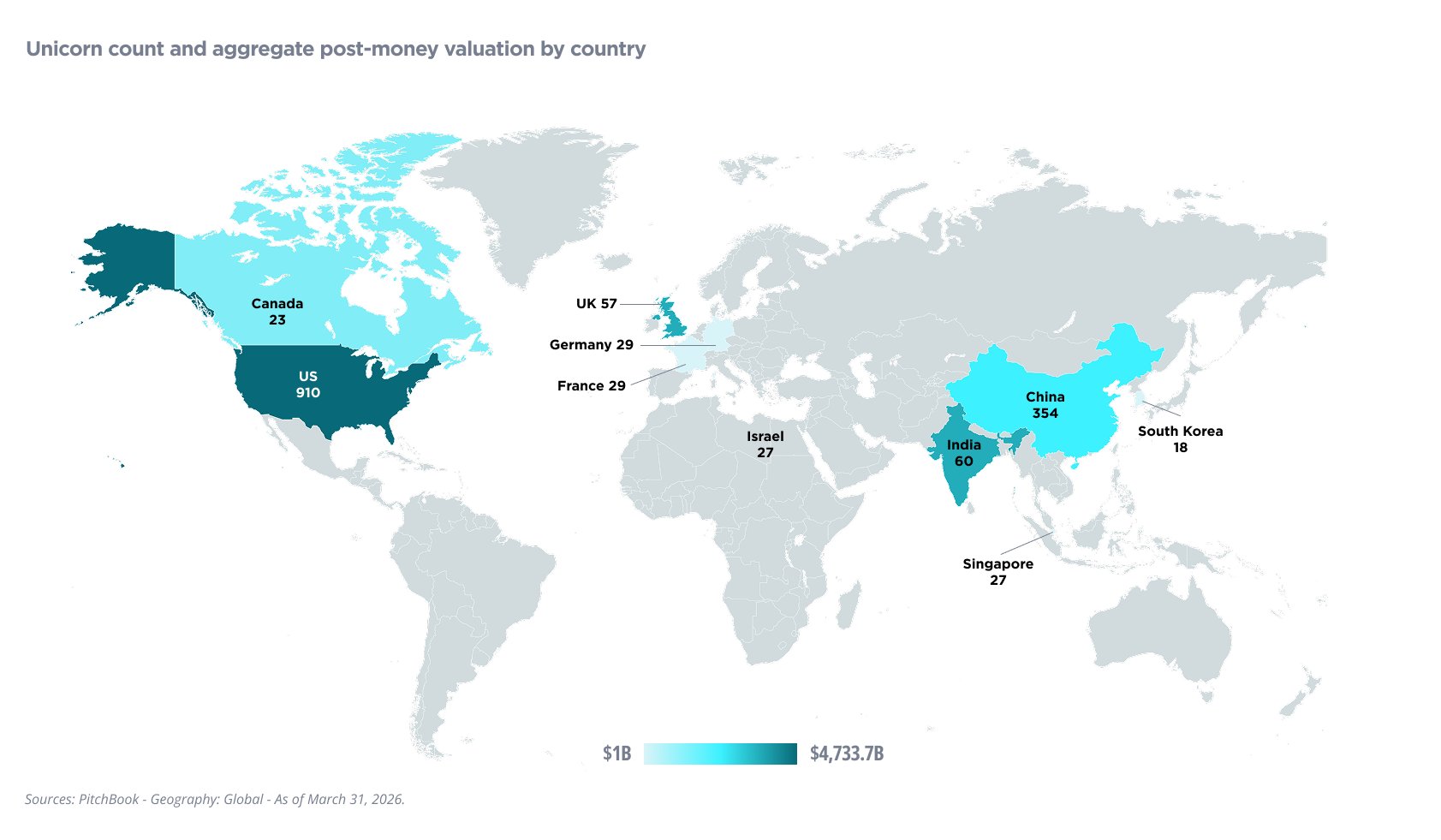
Pull up a map of the world's unicorns and the imbalance is hard to miss. The United States alone accounts for 910 unicorns, more than China, India, the UK, Germany, France, Israel, Singapore, Canada, and South Korea combined. China sits a distant second at 354, and from there the numbers fall off fast: the UK at 57, India at 60, and most other major economies stuck in the 20s and 30s.
This concentration compounds on itself. Deep capital markets attract ambitious founders. Ambitious founders attract more capital and talent. That capital and talent build the infrastructure, cap table, and investors that make the next company easier to start and scale. Each cycle widens the distance between the leading ecosystems and everyone else, which is why a handful of markets keep producing an outsized share of the world's most valuable private companies.
For institutional investors, that concentration isn't a risk to diversify away from, but rather the map of where value creation is happening. The Stableton Morningstar PitchBook Unicorn 20 strategy is built for this reality, providing direct exposure to the private technology leaders shaping the center of gravity in today's unicorn economy.
THE UNTOLD UNICORN STORY
Rippling: From ashes to empire
 Parker Conrad, CEO & Co-Founder of Rippling. (31)
Rippling was built in the wreckage of a very public failure. In February 2016, Parker Conrad was forced to resign as CEO of Zenefits after regulators discovered the company had used unlicensed brokers to sell health insurance. Six weeks later, Conrad was building again. (32)
He and former Zenefits engineer Prasanna Sankar spent two years in stealth mode, coding in Conrad's San Francisco home, determined to prove everyone wrong. Where Zenefits had focused narrowly on benefits and compliance, Rippling would manage everything that touches an employee: payroll, devices, apps, expenses, and access, all in one system. The bet paid off. Today, Rippling is valued at $16.8 billion with over 20,000 customers. (33)
Fun Fact: In 2022, Conrad revealed that he personally manages all of Rippling's internal administration himself, including payroll, using Rippling's own software. For a company with thousands of employees, this is almost unheard of, but Conrad sees it as proof that the product works. (34)
Did you know? Rippling is one of the 20 companies in our Stableton Morningstar PitchBook Unicorn 20 strategy, a systematic, index approach that aims to outperform public benchmarks with low-cost fees, and without a performance fee. Click below for more information.
SOURCES
1 - Financial Times, 2 - NPR, 3 - CNBC, 4 - The Guardian, 5 - Bloomberg, 6 - Figure AI, 7 - The Guardian, 8 - Nikkei Asia, 9 - USNI News, 10 - Forbes, 11 - Financial Times, 12 - Financial Times, 13 - PR Newswire, 14 - The Information, 15 - Cerebras, 16 - The Information, 17 - The Block, 18 - CNBC, 19 - Bloomberg, 20 - Decrypt, 21 - TechCrunch, 22 - Reuters, 23 - CNBC, 24 - Reuters, 25 - xAI, 26 - Financial Times, 27 - Fintech Global, 28 - Financial Times, 29 - Bizjournals, 30 - Shield AI, 31 - The Information, 32 - BuzzFeed News, 33 - TechCrunch, 34 - Forbes



Every Wednesday, the Navigator delivers a digest of news from our portfolio holdings and key trends shaping private tech investing. Subscribe to receive it directly in your inbox.


