




SpaceX Targets $60B Cursor Acquisition, Anthropic Secures $40B Google Backing, Revolut Plans $200B IPO
By Stableton on April 29th, 2026
Flows are concentrating in AI, infrastructure, and fintech. SpaceX expands its AI footprint through a strategic acquisition, Anthropic scales compute capacity with Google backing, and Revolut moves toward a mega public listing. Let’s dive in…
THIS WEEK’S BREAKING NEWS
SpaceX moves to acquire Cursor for $60B AI push
SpaceX has secured the right to acquire Cursor (via parent Anysphere) for $60B, aiming to strengthen its position against OpenAI and Anthropic. The deal includes a $10B termination fee and capitalizes on Cursor’s $2B+ revenue and developer base, integrating it with SpaceX’s compute infrastructure ahead of a potential $1.75T IPO. (1)
STABLETON MORNINGSTAR PITCHBOOK UNICORN 20 STRATEGY

The Stableton Morningstar PitchBook Unicorn 20 strategy is the world’s first passive, systematic, and semi-liquid approach to investing in the Top 20 privately held tech companies before they go public.
This strategy offers a straightforward and cost-effective way to gain exposure to leading private technology companies within a single portfolio. With no performance fees and enhanced liquidity, it offers a unique alternative to traditional private market investments.
PORTFOLIO NEWS
Anduril’s strategic role elevates with Golden Dome program
The U.S. Space Force awarded up to $3.2B in prototype contracts to 12 companies, notably Anduril, alongside SpaceX and Lockheed Martin, to develop space-based missile interceptors under the Golden Dome program, targeting deployment capability by 2028. Fast-track procurement highlights urgency as missile threats evolve, while potential system costs of up to $542B raise questions around long-term scalability and defense budget allocation. (2)
U.S Naval warfare scales as Anduril deploys USVs via Kraken partnership
Anduril is partnering with Kraken Technology Group to deliver small, high-performance unmanned surface vessels (USVs) to the U.S. Navy, combining Kraken’s proven offshore-tested platforms with Anduril’s Lattice autonomy and U.S.-based manufacturing. The K5 KRAKEN and K7 SABRE aim to meet rising demand for scalable, payload-flexible naval systems, with parallel production for allied markets. (3)
Anthropic enters Japan market through NEC enterprise push
NEC Corporation has partnered with Anthropic as its first Japan-based global partner to deploy secure, industry-specific AI solutions across finance, manufacturing, and government. The collaboration integrates Claude into NEC’s BluStellar platform, with rollout to ~30,000 employees globally, strengthening AI-native engineering capabilities and enhancing cybersecurity services amid rising enterprise demand for compliant, secure AI adoption. (4)
Google commits $40B to Anthropic compute race
Google plans to invest up to $40B in Anthropic, including $10B upfront at a $350B pre-money valuation, with an additional $30B tied to milestones. The partnership expands a broader infrastructure commitment, including a 5GW data center buildout potentially worth $200B, as Anthropic’s revenue surpasses $30B and compute constraints intensify amid rising enterprise demand. (5)
European banks test Mythos as regulators push broader access
Anthropic plans to extend access to its Mythos model to European and UK banks within days or weeks, following initial deployment to select U.S. institutions and ~40 critical infrastructure organizations. Regulators warn the model could outpace banks’ governance frameworks, with calls for broader access to avoid systemic risk, as institutions shift toward embedding AI across enterprise-wide risk management and cybersecurity. (6)
Applied Intuition brings AI software layer to HII naval platforms
HII has partnered with Applied Intuition to integrate AI into next-generation naval platforms via Warship OS, a unified software layer connecting sensors, data, and decision-making. Initial deployment targets unmanned surface vessels, with plans to expand across crewed and underwater systems, aiming to accelerate capability updates, reduce integration complexity, and enable software-defined naval operations. (7)
Cursor integrates Chainguard to mitigate AI-driven supply chain risks
Chainguard and Cursor partnered to secure agentic software development by embedding a trusted open-source layer into AI-generated code workflows. With 84% of developers already using AI agents, the integration mitigates rising supply chain risks by providing 2,300+ container images and millions of verified libraries, ensuring malware-resistant, continuously updated dependencies without disrupting developer workflows. (8)
OpenAI brings GPT-5.5 through Databricks partnership
Databricks is partnering with OpenAI to bring GPT-5.5 to enterprise data workflows, positioning the model for agentic work, document reasoning, and long-horizon coding through Codex. On Databricks’ OfficeQA benchmark, GPT-5.5 scored 64.66% with provided documents, up from 57.14%, and 52.63% in a full-agent workflow, reducing errors by 46% versus GPT-5.4. (9)
Kraken lists QCAD, expanding compliant CAD stablecoin access
DeFi Technologies announced that QCAD, developed by portfolio company Stablecorp, is now live for trading on Kraken, marking a key distribution milestone for Canada’s first compliant CAD stablecoin. The listing expands global access and liquidity, positioning QCAD as a regulated on-chain settlement layer supporting institutional adoption of digital asset infrastructure. (10)
OpenAI to commit $1.5B in AI deployment venture across PE portfolios
OpenAI is in talks to commit up to $1.5B to a $10B joint venture with private equity firms including TPG and Bain Capital to accelerate AI deployment across portfolio companies. The venture, DeployCo, targets enterprise adoption bottlenecks, offering embedded AI integration with a 17.5% return floor for investors, signaling a shift from model development to scaled deployment monetization. (11)
OpenAI launches GPT-5.5, a push deeper towards autonomous computing
OpenAI launched GPT-5.5, advancing capabilities in coding, data analysis, and autonomous task execution with reduced user guidance. Released less than two months after GPT-5.4, the model achieved a “High” cybersecurity risk classification following extensive testing, reflecting growing capability. The rollout targets paid ChatGPT users and Codex, as competition intensifies with Google and Anthropic. (12)
OpenAI expands image generation with Images 2.0
OpenAI launched ChatGPT Images 2.0, enhancing image generation with multi-image outputs, improved text rendering, and reasoning-based capabilities such as web search and structured prompt execution. The model supports customizable formats and more detailed outputs, though non-English text remains inconsistent. Available globally across ChatGPT and Codex, it aims to drive user engagement and expand multimodal AI adoption. (13)
OpenAI caps Microsoft revenue share, expands multi-cloud strategy
OpenAI and Microsoft revised their partnership, capping OpenAI’s 20% revenue share payments through 2030 and ending Microsoft’s obligation to share revenue on Azure sales. OpenAI gains flexibility to distribute across other clouds, including Amazon and Google, while Microsoft retains non-exclusive IP rights through 2032, signaling a shift toward multi-cloud enterprise AI deployment. (14)
Revolut prepares $200B IPO before 2028 listing
Revolut is targeting a $150B–$200B valuation for a potential IPO no earlier than 2028, following rapid growth from a $75B valuation in its latest round. With £1.7B pre-tax profit on £4.5B revenue and a newly secured UK banking license, the company is preparing a secondary sale above $100B while positioning for global banking expansion. (15)
Revolut winds down commodities amid European expansion
Revolut will wind down its commodities offering in select European markets, giving affected customers 60 days to liquidate positions in gold, silver, platinum, and palladium. The move impacts a limited user base despite £739M in precious metals exposure in 2025. The decision comes as Revolut continues its banking expansion across Europe, including a license application in France. (16)
Ripple and K Bank advance remittance infrastructure in Asia
K Bank has partnered with Ripple to test blockchain-based cross-border remittance solutions, focusing on speed, cost efficiency, and transparency. Ongoing trials include wallet-based verification, on-chain transfers to the UAE and Thailand, and potential integration of Ripple’s Palisade wallet, positioning the collaboration as a step toward scalable, compliant digital payment infrastructure. (17)
SpaceX courts Wall Street with multi-day analyst briefings
SpaceX is advancing its IPO process with a three-day analyst event across Starbase and its Memphis data center, targeting a late June debut and a potential $75B raise at a ~$1.75T valuation. The roadshow highlights its integrated aerospace and AI infrastructure strategy, as investors assess valuation frameworks beyond traditional peers ahead of one of the largest IPOs in history. (18)
DoorDash uses Stripe-backed Tempo for cross-border payouts
DoorDash will use Tempo to pay delivery workers in stablecoins across 40+ countries, targeting faster settlement, lower FX costs, and simplified cross-border payouts. The payments-focused blockchain, backed by Stripe and Paradigm, positions stablecoins as scalable infrastructure for enterprise payroll and global payment flows. (19)
DOJ backs xAI challenge to Colorado AI regulation
The U.S. Justice Department has intervened in xAI’s lawsuit challenging Colorado’s AI law, arguing it violates constitutional protections by mandating bias mitigation standards. The law, set to take effect June 30, targets “high-risk” AI systems across sectors like finance and healthcare. The case escalates into a federal-state conflict, highlighting growing pressure for a unified national AI regulatory framework. (20)
OTHER NEWS
ByteDance among firms facing China’s new US investment rules
China is moving to require government approval for U.S. investment into leading tech firms, including AI startups and companies like ByteDance, following heightened scrutiny after Meta’s $2B AI deal. The policy aims to protect sensitive technologies and limit foreign ownership in strategic sectors, signaling tighter control over capital flows as U.S.–China tech tensions escalate. (21)
Cerebras IPO tests AI infrastructure valuations in public markets
Cerebras Systems’ planned IPO is set to test the gap between secondary-market pricing and public-market valuation discipline. While private secondary trades have often priced the company at a premium driven by limited supply and momentum, public markets will anchor valuation to fundamentals, creating a potential recalibration moment for AI infrastructure assets. (22)
Mistral strengthens position in global AI competition with xAI and Cursor partnership
xAI is exploring a three-way partnership with Mistral and Cursor to compete with OpenAI and Anthropic. The discussion positions Mistral as a key independent AI lab within a broader effort to combine infrastructure, models, and developer tools to close capability gaps in the AI race. (23)
Shield AI draws Jetstream interest in autonomous defense systems
Shield AI is attracting interest from Jetstream Venture Fund as part of its Future of Air and Space strategy, targeting autonomous defense systems. The company’s Hivemind AI enables drones and aircraft to operate without GPS or communications and is already deployed across U.S. and allied programs, positioning it at the center of growing institutional capital flows into AI-driven defense technologies. (24)
Vast Data hits $30B as Nvidia backs AI infrastructure scale
Nvidia backed Vast Data in a $1B funding round, valuing the company at $30B, more than tripling its 2023 valuation. Vast, which supports data infrastructure for AI workloads across millions of GPUs, reported $4B in cumulative bookings and $500M+ ARR, underscoring growing demand for scalable data layers powering frontier AI systems. (25)
CHART OF THE WEEK
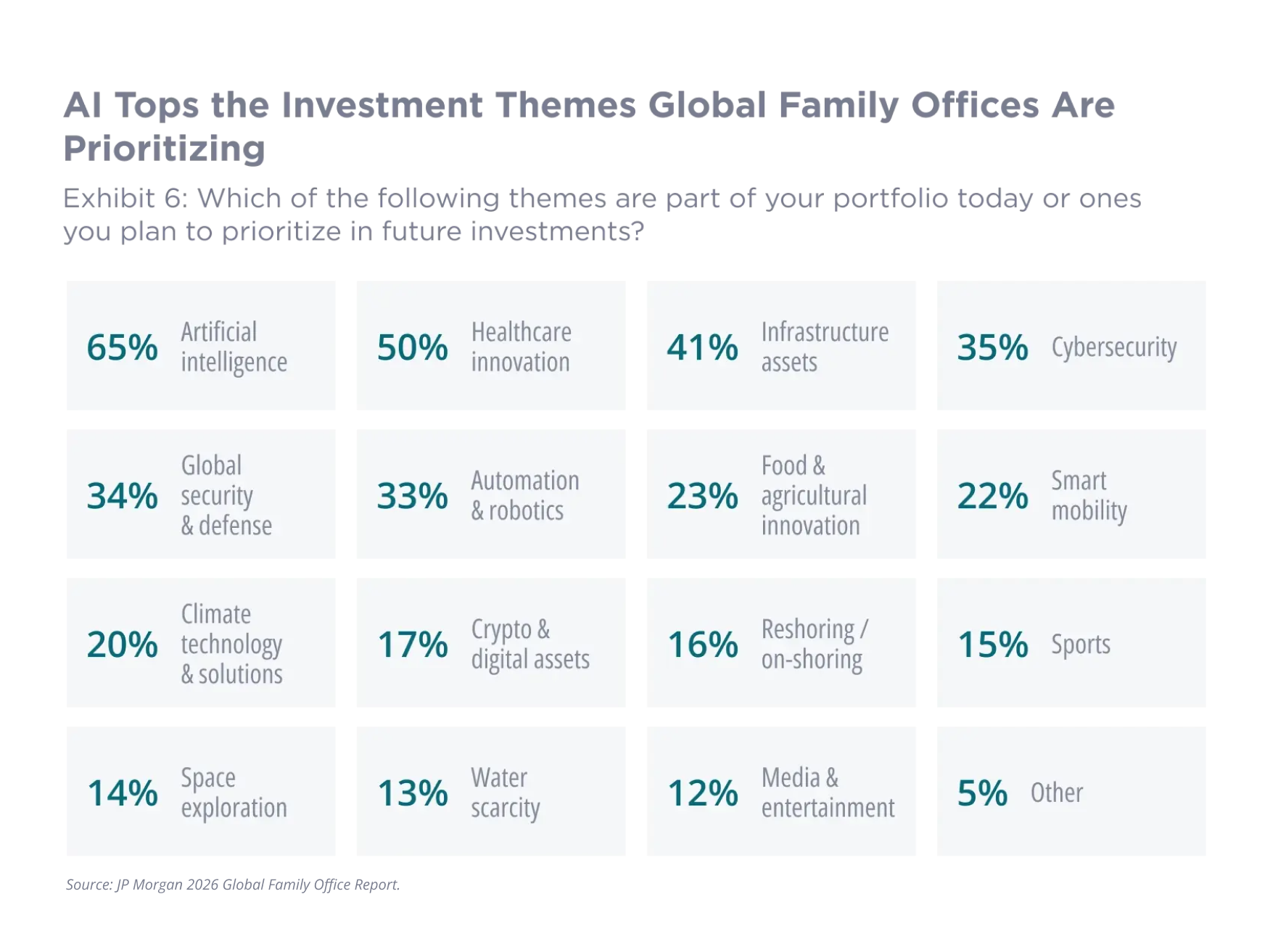
Family offices are converging around a clear set of priorities, with artificial intelligence emerging as the dominant investment theme globally. What stands out is not just AI’s lead position, but its ability to cut across multiple categories, from healthcare innovation and infrastructure to automation, cybersecurity, and defense. This reflects a shift in how themes are being framed.
This thematic concentration reinforces the growing role of private markets in capturing early and sustained value creation. The Stableton Morningstar PitchBook Unicorn 20 strategy aligns with this direction, focusing on late-stage private blue-chip technology leaders operating at the intersection of AI, infrastructure, and innovation, where family offices are increasingly committing long-term capital.
THE UNTOLD UNICORN STORY
Rippling: From ashes to empire
 Parker Conrad, CEO & Co-Founder of Rippling. (26)
Rippling was built in the wreckage of a very public failure. In February 2016, Parker Conrad was forced to resign as CEO of Zenefits after regulators discovered the company had used unlicensed brokers to sell health insurance. Six weeks later, Conrad was building again. (27)
He and former Zenefits engineer Prasanna Sankar spent two years in stealth mode, coding in Conrad's San Francisco home, determined to prove everyone wrong. Where Zenefits had focused narrowly on benefits and compliance, Rippling would manage everything that touches an employee: payroll, devices, apps, expenses, and access, all in one system. The bet paid off. Today, Rippling is valued at $16.8 billion with over 20,000 customers. (28)
Fun Fact: In 2022, Conrad revealed that he personally manages all of Rippling's internal administration himself, including payroll, using Rippling's own software. For a company with thousands of employees, this is almost unheard of, but Conrad sees it as proof that the product works. (29)
Did you know? Rippling is one of the 20 companies in our Stableton Morningstar PitchBook Unicorn 20 strategy, a systematic, index approach that aims to outperform public benchmarks with low-cost fees, and without a performance fee. Click below for more information.
SOURCES
1 - Financial Times, 2 - Fortune, 3 - Anduril, 4 - NEC Global, 5 - Financial Times, 6 - Reuters, 7 - The Defense Post, 8 - PR Newswire, 9 - Databricks, 10 - PR Newswire, 11 - Financial Times, 12 - CNBC, 13 - WIRED, 14 - CNBC, 15 - Financial Times, 16 - Reuters, 17 - Bitget, 18 - CNBC, 19 - Decrypt, 20 - Reuters, 21 - Bloomberg, 22 - The Wall Street Journal, 23 - Business Insider, 24 - The Defense Post, 25 - CNBC, 26 - The Information, 27 - BuzzFeed News, 28 - TechCrunch, 29 - Forbes



Every Wednesday, the Navigator delivers a digest of news from our portfolio holdings and key trends shaping private tech investing. Subscribe to receive it directly in your inbox.


